





How we know what lies at Earth's core
18.08.2015 12:00


Humans have been all over the Earth. We've conquered the lands, flown through the air and dived to the deepest trenches in the ocean. We've even been to the Moon. But we've never been to the planet's core.
We haven't even come close. The central point of the Earth is over 6,000km down, and even the outermost part of the core is nearly 3,000 km below our feet. The deepest hole we've ever created on the surface is the Kola Superdeep Borehole in Russia, and it only goes down a pitiful 12.3 km.
All the familiar events on Earth also happen close to the surface. The lava that spews from volcanoes first melts just a few hundred kilometres down. Even diamonds, which need extreme heat and pressure to form, originate in rocks less than 500km deep.
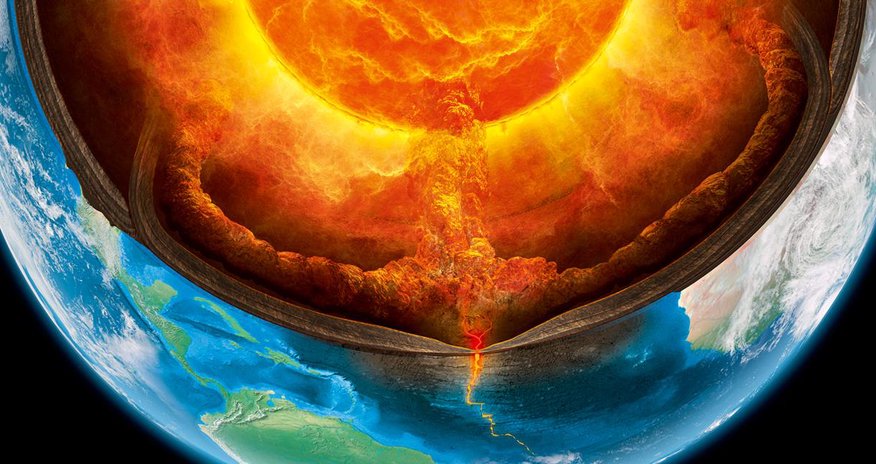
What's down below all that is shrouded in mystery. It seems unfathomable. And yet, we know a surprising amount about the core. We even have some idea about how it formed billions of years ago – all without a single physical sample. This is how the core was revealed.
One good way to start is to think about the mass of the Earth, says Simon Redfern of the University of Cambridge in the UK.
We can estimate Earth's mass by observing the effect of the planet's gravity on objects at the surface. It turns out that the mass of the Earth is 5.9 sextillion tonnes: that's 59 followed by 20 zeroes.
There's no sign of anything that massive at the surface.
"The density of the material at the Earth's surface is much lower than the average density of the whole Earth, so that tells us there's something much denser," says Redfern. "That's the first thing."
Essentially, most of the Earth's mass must be located towards the centre of the planet. The next step is to ask which heavy materials make up the core.
The answer here is that it's almost certainly made mostly of iron. The core is thought to be around 80% iron, though the exact figure is up for debate.
The main evidence for this is the huge amount of iron in the universe around us. It is one of the ten most common elements in our galaxy, and is frequently found in meteorites.
Given how much there is of it, iron is much less common at the surface of the Earth than we might expect. So the theory is that when Earth formed 4.5 billion years ago, a lot of iron worked its way down to the core.
That's where most of the mass is, and it's where most of the iron must be too. Iron is a relatively dense element under normal conditions, and under the extreme pressure at the Earth's core it would be crushed to an even higher density, so an iron core would account for all that missing mass.
But wait a minute. How did that iron get down there in the first place?
The iron must have somehow gravitated – literally – towards the centre of the Earth. But it's not immediately obvious how.
Most of the rest of the Earth is made up of rocks called silicates, and molten iron struggles to travel through them. Rather like how water on a greasy surface forms droplets, the iron clings to itself in little reservoirs, refusing to spread out and flow.
(BBC)
www.ann.az


Telegram
Follow us on Telegram


Similar news
Similar news












 Photo




 Video


