





The brain grown in a LAB
19.08.2015 14:01


A near-complete human brain comparable with that of a five-week-old foetus has been grown in a laboratory dish.
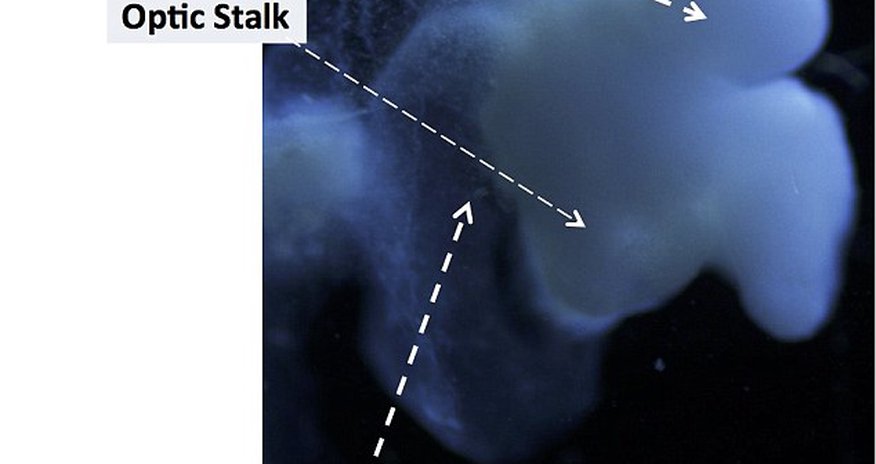
The brain 'organoid' was created from reprogrammed skin cells and is about the size of a pencil eraser.
Scientists hope the lumpy mass of functioning nerve cells and fibres will prove to be a valuable research tool for non-animal testing of new drugs and investigating brain disorders such as Alzheimer's.
As well as neurons and their signal-carrying projections - axons and dendrites - the 'brain' also contains support and immune cells.
It has 99% of the genes present in the foetal brain, a rudimentary spinal cord, and even the beginnings of an 'eye'.
Lead researcher Professor Rene Anand, from Ohio State University in the US, said: 'It not only looks like the developing brain, its diverse cell types express nearly all genes like a brain.
'We've struggled for a long time trying to solve complex brain disease problems that cause tremendous pain and suffering.
'The power of this brain model bodes very well for human health because it gives us better and more relevant options to test and develop therapeutics other than rodents.'
To build the replica brain, the team transformed adult skin cells into induced pluripotent stem (iPS) cells by altering their genes.
'The artificially created stem cells were then coaxed into developing the different cell types and signalling circuitry of the brain.
Full details of the brain growing process are being kept confidential by the scientists but involved causing the stem cells to differentiate into the full range of brain tissues.
The organoid was allowed to grow to the equivalent of 12 weeks in the womb, almost matching the maturity of a five-week-old foetal brain.
'If we let it go to 16 or 20 weeks that might complete it, filling in that 1% of missing genes,' said Prof Anand. 'We don't know yet.'
He spoke about the work at the 2015 military health system research symposium, run by the US department of defence, in Fort Lauderdale, Florida, US.
Already the scientists have gone on to create brain organoid models of Alzheimer's and Parkinson's disease, and autism, in a dish.
With the addition of a blood circulation, which is currently lacking, they also hope to use the model to study stroke therapies.
Military applications include research on Gulf War syndrome, traumatic brain injury, and post-traumatic stress disorder.
(dailymail.co.uk)
www.ann.az


Facebook
Follow us on Facebook


Similar news
Similar news










 Photo




 Video


