





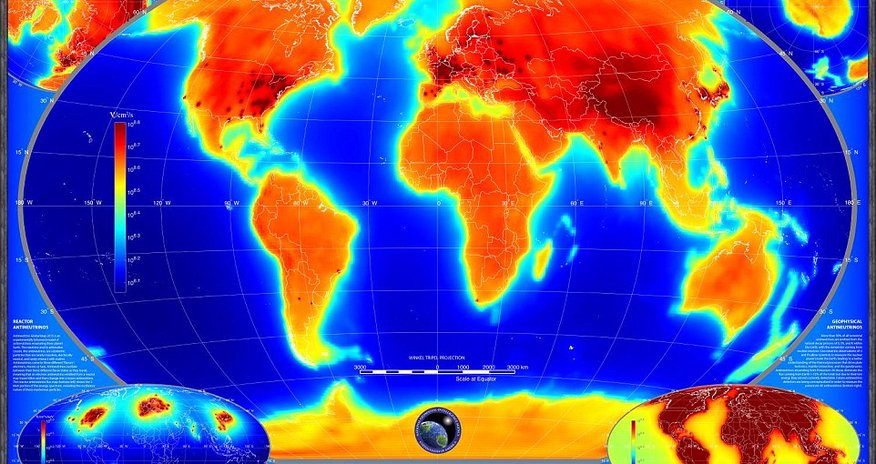
First 'nuclear' map of our planet
03.09.2015 23:30


What goes on beneath Earth's crust is one of the biggest mysteries facing geophysicists.
Scientists have a rough idea of how much heat is produced from Earth's interior – but exactly where that heat is produced has, until now, been difficult to pinpoint.
Now, a new map of global antineutrino emissions could shed light on our planet's interior, as well as the heat processes that take place within it.
The map, the first to ever map antineutrino emissions in detail, could also help scientists monitor sources of man-made radiation created by nuclear reactors.
The neutrino and its antimatter cousin, the antineutrino, are the tiniest subatomic particles known to science.
These particles are by-products of nuclear reactions within stars, supernovae, black holes and human-made nuclear reactors.
They also result from radioactive decay deep within the Earth, where the heat left over from the planet's formation fuels plate tectonics, volcanoes and Earth's magnetic field.
The map, published online in the journal Scientific, provides an image of how heat is moving in our planet's interior to shed more light on these processes.
This antineutrino map may mark the start of a new scientific subfield,' said University of Hawaii Professor John Learned.
'This map is similar to making the first map of North America after Columbus arrived, in that those early explorers had fragmentary information from a few scattered outings and used it to create a comprehensive tool for many others.'
'The interior of Earth is quite difficult to see, even with modern technology,' added William McDonough, professor of geology at University of Maryland and a co-author of the study.
'This map should prove particularly useful for future studies of processes within the lower crust and mantle.'
Neutrinos are notoriously difficult to study; their tiny size and lack of electrical charge enables them to pass straight through matter without reacting.
At any given moment, trillions of neutrinos are passing through every structure and living thing on Earth.
Antineutrinos are slightly easier to detect, through a process known as inverse beta decay.
Spotting these reactions requires a huge detector the size of a small office building, housed about a mile underground to shield it from cosmic rays that could yield false positive results.
In the current study, the team looked at data collected from two such detectors—one in Italy and one in Japan—to generate a picture of antineutrino emissions from natural sources deep within Earth.
They combined this with data collected by the International Atomic Energy Agency (IAEA) on more than 400 operational nuclear reactors.
Overall, antineutrinos from these human-made sources accounted for less than 1 per cent of the total detected.
'Keeping tabs on nuclear reactors is important for international safety and security,' said McDonough.
'But as a geologist, I'm particularly excited for the potential to learn more about Earth's interior.
'This project will allow us to access basic information about the planet's fuel budget across geologic time scales, and might yet reveal new and exciting details on the structure of the deep Earth.'
The team plans to make updates to the global antineutrino map in the future, with the help of improved models of Earth's interior and better antineutrino detection technology.
'Antineutrinos are only one particle produced by Earth's natural radiation,' explained Shawn Usman, R&D Scientist at the National Geospatial-Intelligence Agency and lead author of the study.
'The National Geospatial-Intelligence Agency is working with UMD to develop additional radiation maps to characterise the Earth's naturally-occurring gamma and neutron radiation.'
(dailymail.co.uk)
www.ann.az


Facebook
Follow us on Facebook


Similar news
Similar news












 Photo




 Video


