





NASA: Solar wind transformed Mars into cold, dry planet
06.11.2015 15:30


We now know more about what happened to Mars' climate.
NASA announced on Thursday several major scientific findings by its MAVEN spacecraft that reveal significant details on the fate of the Martian atmosphere.
Scientists have known that billions of years ago, Mars was a wet, warm planet with a thick atmosphere that protected it. The Martian landscape once had water flowing through its long rivers that spilled out into lakes and oceans.
That world is a stark contrast to the dry and bitter cold planet we know it as today. The question researchers have pondered for ages is: What happened to cause such a major transformation?
"Quoting Bob Dylan: 'The answer, my friend, is blowing in the wind,' " said Michael Meyer, lead scientist for the Mars Exploration Program at NASA Headquarter during the announcement.
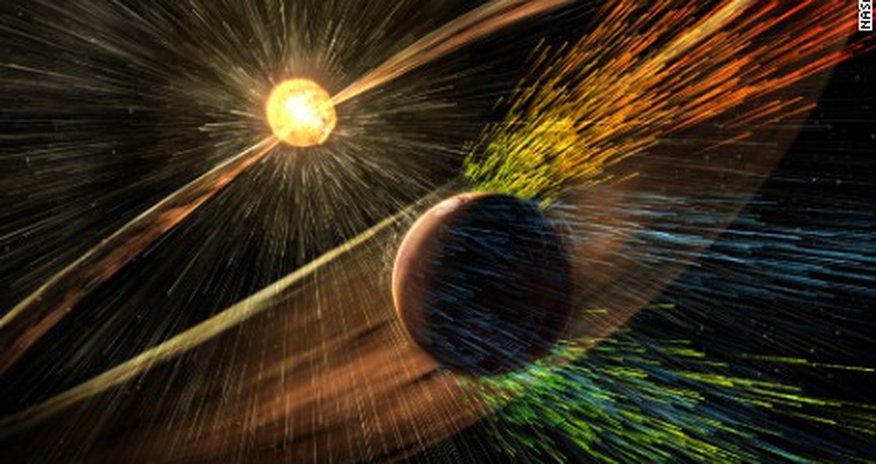
New measurements from the MAVEN, Mars Atmosphere and Volatile Evolution, show solar winds have stripped ions from the Martian atmosphere. Solar wind -- charged particles from the Sun -- have removed gases like oxygen and carbon dioxide from the planet, important elements for understanding the potential for life, according to NASA.
The findings could mean there was big atmospheric loss early in the planet's history.
Mars' atmospheric fate could theoretically happen on Earth which is also losing ions, but NASA said during the conference that our planet is fine for now because of its magnetic field.
The MAVEN has also discovered auroras on Mars that are similar to Earth's northern lights. On our planet, auroras form when charged particles from the solar winds enter Earth's magnetic field and travel to the poles where the particles collide with atoms of gas in the atmosphere.
But the auroras on Mars may be caused by what is left of the magnetic field on the planet's crust, which means these northern lights are spread out across a bigger area.
Another major finding shows that Mars' notorious dust problem is believed to be interplanetary in origin, meaning from another planet. Scientists came to this conclusion based on the grains and distribution of dust on Mars' surface, which ruled out Martian moons Phobos and Deimos as the culprits.
The MAVEN has been on a mission to study Mars' upper atmosphere since its arrival to the planet's orbit in September 2014. Tasked with finding how Mars' climate changed in the last 4 billion years, it's possible we're closer to understanding future habitability on the planet.
(CNN)
www.ann.az


Facebook
Follow us on Facebook


Similar news
Similar news












 Photo




 Video


