





Watch a planet being BORN
24.11.2015 19:29


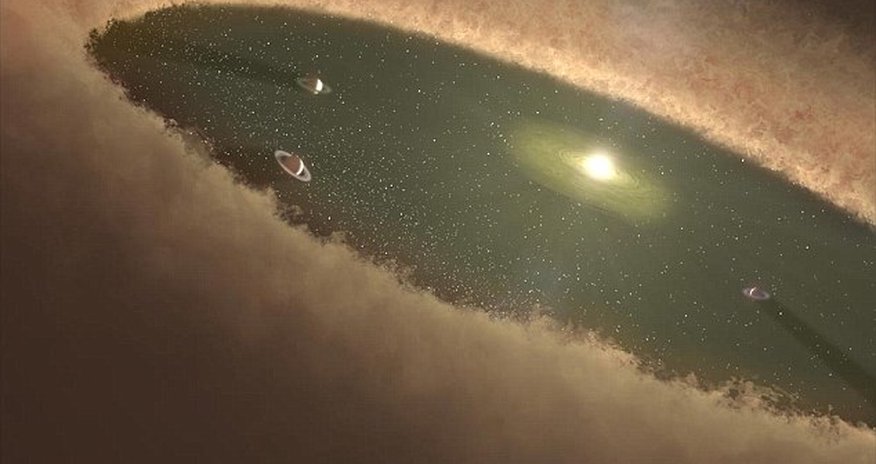
The birth of a planet as it forms from the cosmic clouds of gas and dust particles that surround it has been directly observed for the first time.
Researchers in Arizona have been studying LkCa 15, a young star surrounded by a ring of debris, because they believed it may be accumulating into a planet.
By observing light at various wavelengths, the astronomers have now been proved correct and said LkCa 15 could provide more chances to directly witness similar processes in other regions.
While the process of planet formation and growth by gradual gas and dust accumulation is well-known, it has never been witnessed first-hand until now.
None of the previously discovered planets outside of our solar system are still in their formation stage, which means LkCa 15 offers a unique chance to study this development.
Astronomers regard transition disks - vast rings of gas and dust orbiting around newborn stars - as colossal laboratories for the study of planet formation.
These disks typically present inner clear areas with no visible dust or gas.
This is a phenomenon that has been attributed to fledgling planets sweeping material away as they travel around the star.
Transition disks have previously been found that show evidence of the presence of young planets.
However, this evidence was seen in asymmetries in the disk, or by studying infrared emissions detected within their clearings, and attempts to directly observe signatures of planet formation have been unsuccessful.
The University of Arizona's team, led by Stephanie Sallum, looked into the empty areas around the star LkCa 15, which sits only 430 light years away from Earth.
Their telescopes - the Large Binocular Telescope in Arizona and the Magellan telescopes in Chile - were fitted with adaptive optics in order to correct light distortions.
The team detected emissions at various wavelengths, including infrared and hydrogen-alpha(Hα), coming from the clearings in LkCa's 15 disk.
In a paper published in the journal Nature, the researchers suggest such emissions indicate very hot gas - about 9,700ºC (17,500ºF) - stuck to the core of LkCa 15b.
'Both the infrared and Hα observations show that we are unambiguously witnessing planet formation in LkCa 15,' the paper said.
'The data offer evidence that giant protoplanets undergo a period of high infrared and Hα luminosity during their accretion phase.'
The astronomers concluded that the young LkCa 15 system provides the first opportunity to directly study planet formation and disk-planet interactions.
(dailymail.co.uk)
www.ann.az


Youtube
Follow us on Youtube


Similar news
Similar news












 Photo




 Video


