





Saturn's biggest ring sparks new mystery
04.02.2016 17:30


The planets Jupiter, Neptune and Uranus all have faint rings around them.
Saturn's however really stands out. It has several rings made up of ice and dust particles, with a combined diameter of 270,000 km. These rings are quite thin and therefore extremely hard to see from Earth.
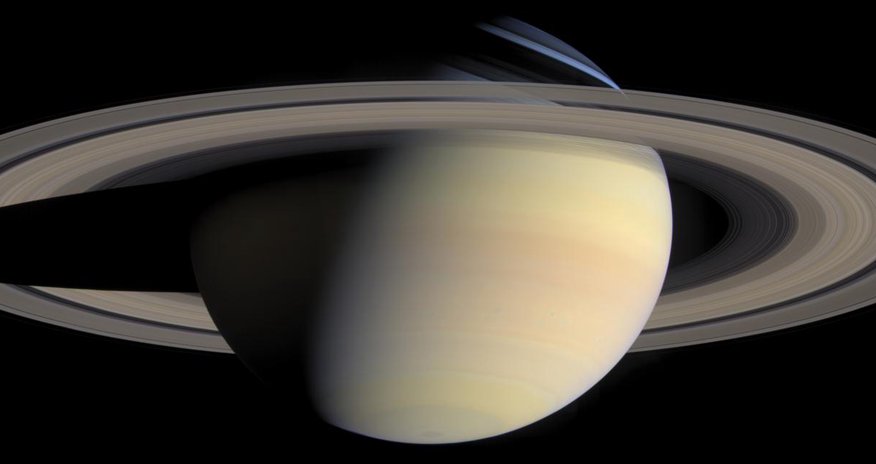
Its biggest and brightest ring - dubbed "B ring" - is also its most opaque, and often registers black on images taken from spacecraft, such as the one below.
In an attempt to weigh Saturn's B ring for the first time, scientists have discovered that parts of it don't have as much mass as expected. A team found that the more opaque areas of the ring were not heavier.
This was a surprising discovery as Saturn's B ring is not the same throughout, some parts are clearer than others.
Dirty water, for example, is heavier than clean, as it contains particles of mud that are heavier than water molecules. Not so for Saturn.
The B ring also had less mass than was expected. Even though parts of the ring were 10 times denser than Saturn's A ring next door, it was only two or three times as heavy.
The study is published in the journal Icarus. To understand B ring's mass, scientists analysed ring matter called "spiral density waves". These are tiny segments of the ring created because of the gravity pulling on them.
Each of these waves has a structure determined by its mass - so knowing the structure allowed the team's to determine the mass, "weighing" them.
The team found that the B-ring's "surface mass density" was between 40 and 140g/cm squared. Roughly speaking, that's equivalent to the weight of a banana per cm squared.
"At present it’s far from clear how regions with the same amount of material can have such different opacities," says Matthew Hedman, the study’s lead author and of the University of Idaho, Moscow, US.
"It could be something associated with the size or density of individual particles, or it could have something to do with the structure of the rings."
Understanding more about Saturn's rings could help determine its age. That's because a smaller ring would attract cosmic dust more quickly because it has less size to fill.
"By 'weighing' the core of the B ring for the first time, this study makes a meaningful step in our quest to piece together the age and origin of Saturn’s rings," says Linda Spilker, of NASA’s Jet Propulsion Laboratory in Pasadena, California, US.
"The rings are so magnificent and awe-inspiring, it’s impossible for us to resist the mystery of how they came to be."
(BBC)
www.ann.az


Instagram
Follow us on Instagram
Similar news
Similar news












 Photo




 Video


