





Single pair of 10,500-year-old hunter-gatherer prints found in a desert
12.12.2013 15:45


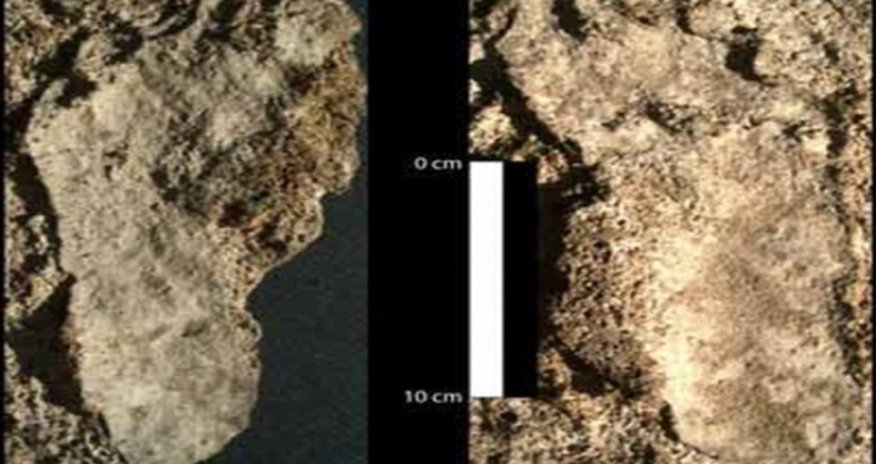
Centuries ago a hunter-gatherer trekked across the desert in search of food and left behind just a single pair of perfectly preserved prints. The prints were originally found in the Cuatro Cienegas Basin of Mexico back in 1961 but researchers from Durham University have now managed to pinpoint when the steps would have been made. It is thought the prints date back some 10,550 years and may have belonged to a member of the Coahuiltecans group of Indians that inhabited the region. The prints were originally discovered when the Mexican Federal Highway 30 was built across the Chihuahuan Desert.They were found encased in stone meaning excavators could remove them in a single piece and store them at a local museum.Once the highway was built, the original location of the prints was lost but researchers did find 11 tracks of additional prints in the Cuatro Ciénegas region surrounding the road. By studying the stone in which the footprints were made, archaeologists from Durham University were able to establish that the single pair of prints was made approximately 10,550 years ago, while the tracks date back around 7,250 years. Geoarchaeologist Dr. Nicholas Felstead who led the dig said: ‘To my knowledge the oldest human prints previously reported in North America are around 6,000 years old so these prints predate them by some 5,000 years.’ He continued that the prints are the only reported footprints ever found in the Cuatro Cienegas region.Felstead was able to date the tracks because they had been made in a sedimentary rock called travertine. As water seeps through travertine, small traces of uranium remain inside the rock and because uranium decays at expected rates, Felstead and his team could measure ‘the ratio of those materials’ to determine the ages. The team also found pollen from trees inside the 7,200-year-old tracks which suggests the region wasn’t always as dry and hot as it is today.Among this was pollen from a so-called prickly pear cactus that grew during the time of the Coahuiltecans - a group of hunter-gatherers that lived in the region. The Coahuiltecan people is the collective name for a small group of Indians that lived in the flat areas of southern Texas and on the coast of the Gulf of Mexico, and it is thought the prints may have belonged to a member of this group. This also gave clues as to why the area became uninhabited in more recent years, when the area became arid and dry. The prints are not the oldest known footprints in the world - a track of prints were found at Monte Verde in Chile that is thought to date back 13,000 years - but they are the oldest discovered on the continent of North America. The prints are now being stored at Saltillo’s Museo del Desierto. (dailymail.co.uk)ANN.Az


Youtube
Follow us on Youtube


Similar news
Similar news












 Photo




 Video


