





The science of ZOMBIES
02.01.2015 14:30


Their lumbering, menacing gait and insatiable hunger for flesh strikes fear into even the most seasoned horror film fan.
Now, two neuroscientists have analysed the behaviour of the walking dead to reveal the inner workings of their minds and defined a comprehensive diagnosis of 'zombiism'.
And with this knowledge they have even hatched a plan for how to survive a zombie apocalypse.
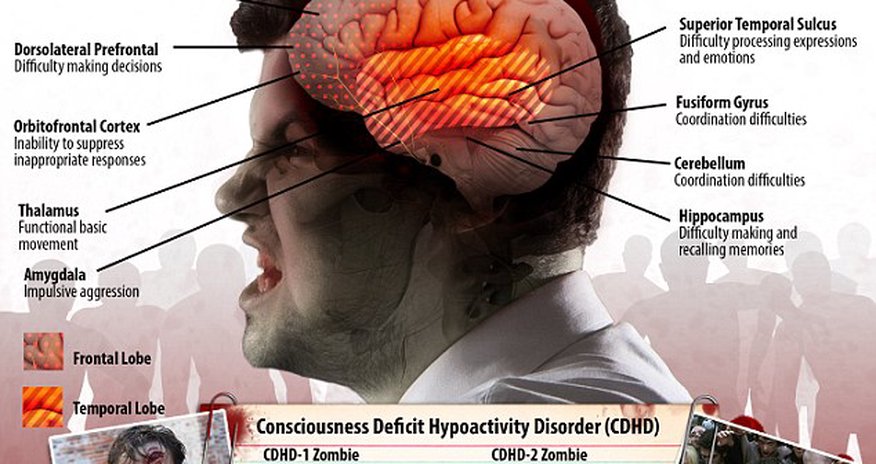
Zombie fanatics Timothy Verstynen, an assistant professor in the department of psychology at Carnegie Mellon University in in Pittsburgh, Pennsylvania, and Bradley Voytek, assistant professor of cognitive science and neuroscience at the University of California, San Diego, summarised characteristic zombie behaviour seen in films, which can be explained by looking at the structure of the brain.
They have dubbed the condition 'Conscious Deficit Hypoactivity Disorder', or CDHD, which they describe as an acquired syndrome in which infected people lack control over their actions.
In films, the undead display symptoms such as lethargic movement, loss of pleasure, language dysfunction, amnesia and the inability to suppress hunger and aggression.
‘Zombies often have difficulty recognising familiar people and suffer chronic insomnia that results in a delirious state,’ they write.
Undead individuals would also exhibit antisocial behaviour, such as biting and eating people, but they would be friendly to each other and swarm with other infected individuals, according to the scientists’ book, ‘Do zombies dream of undead sheep?’.
The neuroscientists have come up with two subtypes of the syndrome – CDHD-1, which affects ‘slow’ zombies with uncoordinated movements and CDHD-2, which is typical of ‘fast’ zombies that have no problem chasing humans in films.
This may be because at the moment of death, our circulatory systems stop, starving the brain of oxygen and glucose.
In zombie films, they resume at the point of infection - in a limited form - and the brain gets its nutrients by zombies feasting on human flesh.
The longer the brain is starved of oxygen, the more extensive the damage to zombies, the neuroscientists say.
CDHD-1 zombies can be seen in the TV series, The Walking Dead, while the zombies in Waord War Z are faster and typical of CDHD-2.
The brains of both types of zombies would change in different regions, from a combination of decreased activity and altered activity in multiple brain networks.
Lesions to the temporal lobe would partly cause zombies to act like they do in films.
(dailymail.co.uk)
ANN.Az


Twitter
Follow us on Twitter

Similar news
Similar news












 Photo




 Video


