





Are travel selfies narcissistic?
20.04.2015 17:00


With spring breaks concluding or starting -- depending on where you live in the world -- everyone seems to be taking travel photos. No longer are these photos shared days or weeks after a trip, but instead, they are often shared from the very tourist site they're taken from.
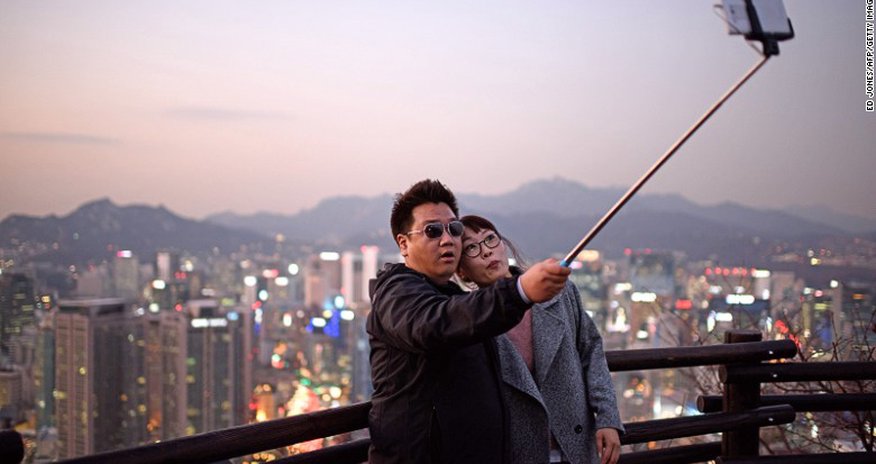
Instead of living in the moment and observing, appreciating and gaining cultural insight while visiting new places, travelers are often more focused on taking the perfect selfie to share on Instagram, Facebook or Twitter and counting the number of likes and shares.
We could blame social media for encouraging this, or blame the selfie stick, which is perhaps the most ubiquitous of all travel gear these days and is now being banned in museums throughout America and abroad because of its intrusiveness. Even Apple announced a ban on selfie stick at its upcoming Worldwide Developers Conference.
We might also choose to label these tourists as narcissistic for taking self-portraits with famous landmarks and catastrophes alike. One study showed that people who post more selfies scored higher on measures of narcissism and anti-social characteristics.
Perhaps selfies are about narcissism, especially those who seem to take them everywhere and all the time, such as Kim Kardashian. But I believe something deeper is behind all the travel selfies -- the need to capture our own place in history.
This need is why some tourists have been caught making their mark, literally, on ancient sites and artifacts around the globe, like the two young American tourists who recently carved their initials on the wall of the nearly 2,000-year-old Roman Colosseum. They were caught just after taking selfies with their new mark on the historic site.
This desire to show that "I was here" is not new; just the mode for expressing it is. Throughout history, travelers have written about the places they visited and their marks have not always been seen as destructive.
When I visited Egypt a few years ago, the tour guide pointed out inscriptions in temples and tombs, noting that early visitors left them long before the age of mass tourism. That was just before a Chinese teenager decided to add his name to one of the statues in the Karnak Temple.
During a rainy visit to Pompeii, I found the same reminders of ancient visitors, faint graffiti on the crumbling walls. Words and images were preserved, put there by people who lived before Vesuvius exploded and covered the town with ash in AD 79.
Travel graffiti has roots in primitive social media. Harkening back to cave paintings and hieroglyphics, travelers want to write on and connect with the spaces they occupy, even temporarily, to enhance social relations, demonstrate status and establish presence. Travelers want to write their names, dates of visit, and maybe where they come from.
They want to do this for the same reason students at Oxford carved their names in dormitories, couples shackled their love locks on the Pont des Arts bridge in Paris, and tourists post their selfies online.
They want to document that they came face-to-face with history and then, when possible, to share that experience with their network of friends, family and followers who could not physically be there.
The Rio statue guy's guide to taking epic selfies
Clearly, the preservation of historical sites is a good reason for prohibiting tourists from inscribing their names and dates of visit. Governments, archeologists and other preservationists spend a great deal of time and money to safeguard sites for future generations.
But it is short-sighted to deny the innately human need to do something while being there. Some tourist destinations are embracing social media by setting up booths to help tourists get the best selfie. When I was in Dubai recently at a popular beach boardwalk, I used one of the open-air selfie booths to capture a few family photos.
Perhaps historical sites should embrace social media more. What if the Colosseum turned the tables and instead of prohibiting people from writing on the stone walls, it launches a social media campaign inviting people to "Come Write on Our Wall" -- as in, their Facebook wall. A new Instagram campaign using the hashtag #smilelikeagladiator might be just the ticket to get tourists to snap photos and connect with the Colosseum and fellow travelers worldwide.
I don't blame tourists for wanting to make a connection with the places they visit and share it in a tangible way. Connection and understanding are, after all, among the reasons to travel, write and take selfies. But tourists need to learn to do it with conservation and cultural sensitivities in mind, something tourist sites can assist with by providing them with a harmless way to engage with history and share those memorable experiences.
(CNN)
www.ann.az


Instagram
Follow us on Instagram
Similar news
Similar news












 Photo




 Video


