





Did Vikings really hail from Azerbaijan?
30.12.2015 12:00


by Paul Salopek
It is freezing in the foothills of the Greater Caucasus range. Rufat Gojayev, my Azerbaijani walking guide, leans into the cold sunlight. He directs his tireless steps towards Kiş.
What is Kiş?
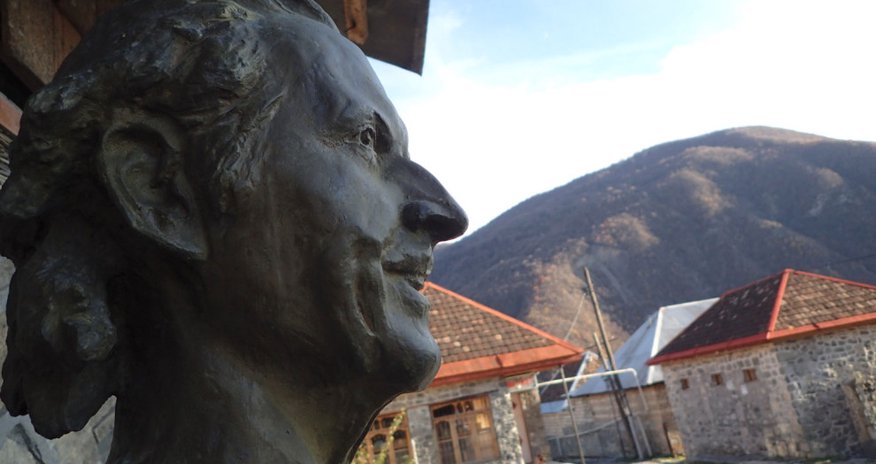
Kiş is a remote mountain village that has preserved what may be the oldest Christian church in Azerbaijan, and perhaps in the whole region: a temple founded, according to local legend, in the first century A.D. Its walls are built of pale weathered stone. Its crypts hold nameless dead. Its garden shines with persimmons that hang like fiery tree ornaments from winter-bare branches. The church features a large bronze bust outside its walls: a grinning Thor Heyerdahl, the fabled Norwegian adventurer. This artifact is puzzling.
"Thor Heyerdahl was a great man,” Khatiza Abdulrahman, a local government guide, tells us. "He discovered that Azerbaijanis and Norwegians are related.”
And so: The global walk stumbles once again into a bizarre and forgotten back eddy of time and place—into another of the world’s obscure mysteries.
Heyerdahl, who is mostly famous for sailing a balsa raft called the Kon-Tiki across the South Pacific in 1947, enjoys something of a cult following in Azerbaijan. Why? The dashing Norseman who bobbed across the world’s oceans in antique boats during the latter half of the 20th century, always hoping to demonstrate how ancient civilizations may have contacted each other by sea, developed his final theory of cultural diffusion at Kiş. He believed the blond and ginger-haired Vikings of Scandinavia—his own ancestors—originated from somewhere in or near this nation of Turkic speaking peoples at the edge of Persia.
His proof?
An 800-year-old Icelandic saga mentions that Odin, the Norse god and a mythic ancestor of the Vikings, migrated to Scandinavia from an eastern land called "As-hov” or Aser.” Thus: Azer-baijan. Add local petroglyphs that depict ships similar to the longboats used by Norse sea raiders to terrorize Europe during the Middle Ages. (Unfortunately, these rock engravings happen to be immensely older than the Vikings, dating back to the Neolithic.) Throw in some vague affinities between Azerbaijani and Norwegian folk music. Mix in a few scraps of allegedly "runic” script unearthed in both nations. And voila: Vikings came from what is today a secular Muslim oil state that, in 2012, scored its own raid against Europe by snatching the Eurovision Song Contest away from three-time host Sweden.
Abdulrahman, the friendly guide at the Kiş village church, speculates that the Norse fled Azerbaijan for the northern fiords in the seventh century, when "Arabs came here, and people became darker and shorter.” Heyerdahl, who died in 2002, pegged his own Viking exodus much earlier, to Roman invasions of the Caucasus in the first century.
Modern researchers sigh wearily at such hypotheses.
"Thor Heyerdahl was a great traveler,” Jeyhun Eminli, an Azerbaijani archaeologist, tells me. "He wasn’t much of a scientist.”
There is no hard evidence, Eminli says, that supports direct Norwegian-Azerbaijani ancestry. A widely cited DNA study linking the two peoples is controversial.
Eminli is brave. Viking heritage has become tangled up somehow with questions of national pride in Azerbaijan.
An Azerbaijani news site impugned the honor of Heyerdahl skeptics by asking a recent academic conference attendee: "Does this mean that mercantilism and fear of loss of influence force some academics and scientific circles to deny anything that is not profitable to them or poses a threat?” (The interviewee agreed: "Quite true!” He was Thor Heyerdahl, Jr., son of Thor.)
Viking mystique endures at tiny Kiş partly because of its graves. Very tall people were buried here between the third and tenth centuries. One man was 6’7″ (two meters) tall. One woman towered to almost 7’3.” Supposedly, this adds credence to the presence of hulking proto-Scandinavians in these snowcapped Eurasian mountains. Perhaps this is why Heyerdahl came here.
We stare down through open pits at the dead—at their long lengths of bone—my walking partner Rufat Gojayev and I. What must it have been like? To be a seven-foot-tall woman in early medieval Azerbaijan? Was she lonely? A powerful presence? Was she loved?
We strike out, Gojayev and I, for the next gravelly river, for the next alpine town.
We all want to belong to some saga.
(National Geographic)
www.ann.az


Youtube
Follow us on Youtube


Similar news
Similar news



Culture 17:29
Over 90% of Azerbaijan's libraries fail international standards, Culture Ministry says







 Photo




 Video


