





Is the sun going dark?
18.03.2015 12:30


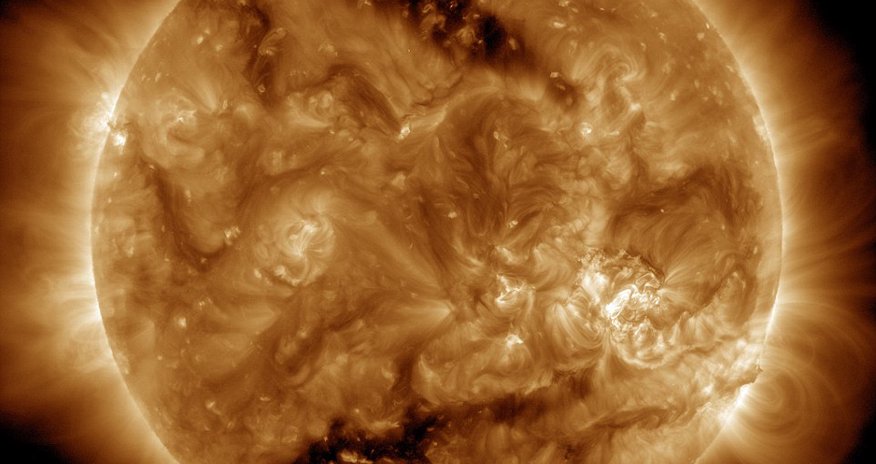
Nasa has spotted a pair of huge 'holes' on the solar surface.
The larger coronal hole of the two, near the southern pole, covers an estimated 6 to 8-percent of the total solar surface, 142 billion miles - making it one of the largest polar holes scientists have observed in decades.
The smaller coronal hole, towards the opposite pole, is long and narrow, covering about 3.8 billion square miles on the sun - only about 0.16-percent of the solar surface.
'Coronal holes are lower density and temperature regions of the sun’s outer atmosphere, known as the corona,' explained Nasa.
'Coronal holes can be a source of fast solar wind of solar particles that envelop the Earth.'
The magnetic field in these regions extends far out into space rather than quickly looping back into the sun’s surface.
Magnetic fields that loop up and back down to the surface can be seen as arcs in non-coronal hole regions of the image, including over the lower right horizon.
The bright active region on the lower right quadrant is the same region that produced solar flares last week.
It is the second time Nasa has spotted a huge hole on the sub.
The sun has started 2015 with a mysterious event - a huge hole has appeared.
Known as a coronal hole, the phenomenon occurred near the south pole - and is seen as a dark area covered all of its base in these stunning images.
Coronal holes were first seen in images taken by astronauts on board NASA's Skylab space station in 1973 and 1974.
They can be seen for a long time, although the exact shape changes all the time.
The polar coronal hole can remain visible for five years or longer.
Each time a coronal hole rotates by the Earth we can measure the particles flowing out of the hole as a high-speed stream, another source of space weather.
Charged particles in the Earth's radiation belts are accelerated when the high-speed stream runs into the Earth's magnetosphere.
The acceleration of particles in the magnetosphere is studied by NASA's Van Allen Probes mission.
The incredible image was captured on Jan. 1, 2015 by the Atmospheric Imaging Assembly (AIA) instrument on NASA's Solar Dynamics Observatory, shows the coronal hole as a dark region in the south.
Coronal holes are regions of the corona where the magnetic field reaches out into space rather than looping back down onto the surface.
Particles moving along those magnetic fields can leave the sun rather than being trapped near the surface. Those trapped particles can heat up and glow, giving us the lovely AIA images.
In the parts of the corona where the particles leave the sun, the glow is much dimmer and the coronal hole looks dark.
As Solar Cycle 24 fades, the number of flares each day will get smaller, but the coronal holes provide another source of space weather that needs to be understood and predicted.
Coronal holes are a typical feature on the sun, though they appear at different places and with more frequency at different times of the sun's activity cycle.
(dailymail.co.uk)
ANN.Az


Telegram
Follow us on Telegram


Similar news
Similar news












 Photo




 Video


