





Scientists to carry out 'autopsy' on life-sized T-Rex replica to solve mysteries of huge predator
19.05.2015 19:30


The Tyrannosaurus Rex has baffled scientists for decades, with mystery still surrounding how it could eat with its tiny arms - and even suggestions the predatory dinosaur had feathers.
But experts could finally be on the verge of solving the carnivore's greatest secrets, after making a life-sized, anatomically complete recreation of the huge dinosaur.
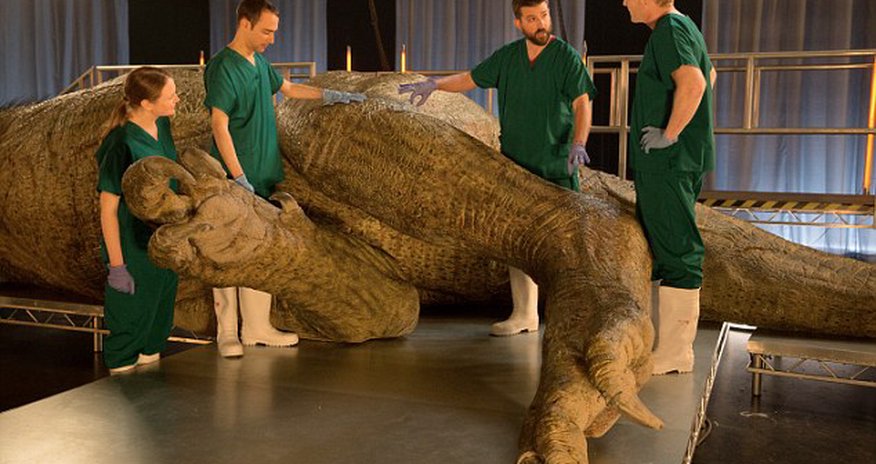
In an unprecedented experiment, palaeontologists will dissect the 14-metre long T-Rex in a specially constructed lab in an attempt to fully understand the reptile.
The National Geographic Channel's T. rex Autopsy will see four scientists cut into the world's first full-size replica of the dinosaur.
The model has eyes the size of grapefruits, teeth which are each a foot long, and a stomach big enough to digest a four-year-old child.
Collaborating with veterinary surgeons, biologists and palaeontologists, the two-hour documentary will show the latest findings about T-Rex.
The scientists hope to use the incredible replica to explore mysteries such as whether the dinosaur was a hunter or a scavenger, how it fed itself with its tiny arms, and whether T-Rex had feathers.
The experts will face the challenge of sawing through the extinct animal's giant bones, wading through blood and even coping with the overwhelming smell of its innards.
Employing industrial-sized tools, veterinary surgeon Dr Luke Gamble, leads a group of palaeontologists that includes Dr Tori Herridge, Dr Steve Brusatte and Matthew T. Mossbrucker, in cutting the 65million-year-old beast open.
Dr Herridge, who has previously conducted an autopsy on a woolly mammoth from the Ice Age, said: 'The chance to take palaeontological evidence and transform that into something tangible in the real world, something we can all recognise and appreciate without expert knowledge, is very special.
'Not to give too much away, but one of the most interesting things we learnt is that the size of the T-Rex heart was not one percent of the body size that is typical in mammals and birds, it was actually smaller than we might have predicted.
'A bigger heart just would not have fit inside the chest cavity. It took delving under its dual rib cages, getting blood all over my arms, to find that out.'
(dailymail.co.uk)


www.ann.az


Twitter
Follow us on Twitter

Similar news
Similar news










 Photo




 Video

