





It's not a 21st century trend after all!
24.07.2015 00:59


In the 21st century there has been an explosion in the number of young men and women getting themselves inked, with tattoo sleeves now seen on every High Street.... but a new book around body art proves the movement is nothing new.
A new tome, titled 100 Years of Tattoos, features hundreds of vintage photographs showing tattoo-mad men and women inked from head-to-toe.
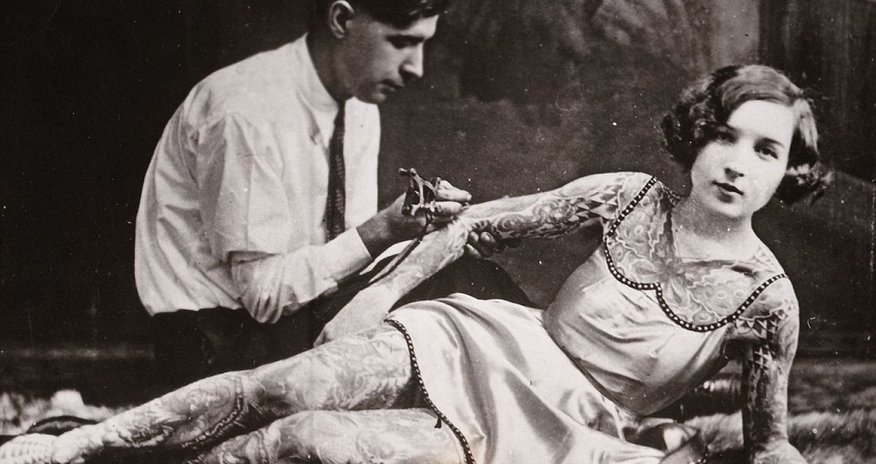
One particularly striking shot from the late 1920s shows a woman laying on her side as a man carefully inks one of her arms to complete her intricate full body suit.
She appears emotionless as the wince-inducing process takes place. But it appears she has spent much time in the tattoo parlour with a butterfly design strewn across her collar bones and flower-like patterns snaking up her limbs.
It's likely the woman pictured made money from her head-turning body art.
By the end of the 1920s, American circuses employed more than 300 people with full-body tattoos who could earn an unprecedented $200 (£128) per week.
Another standout photograph shows Janet 'Rusty' Skuse staring at the camera in a leopard-print bra and pants.
The late redhead had her first tattoo aged 17 in 1961 and went on to be honoured by Guinness World Records as Britain's most tattooed woman.
By 1964, she had 62 tattoos and was fast becoming a celebrity in her own right.
David McComb, who authored 100 Years of Tattoos, said he previously worked for a magazine which would feature modern tattoos and was 'always keen to reach back in time and chart the evolution of tattoos in the West.'
To research the book he read every tattoo book he could get my hands on and began to piece together the history of Western ink.
While according to scientists, the earliest record of tattoos was found in 1991 on the frozen remains of a Copper Age 'Iceman' dating from about 3300 B.C., the art of tattooing has been practiced in Japan - for beautification, magic, and to mark criminals - since around the fifth century B.C.
Restricted from wearing kimonos usually worn by royalty and the elite, lower class women rebelled by wearing tattooed body suits, covering their torsos with illustrations that began at the neck and extended to the elbow and above the knee.
Wearers hid the intricate designs beneath their clothing and it was these repressive laws that gave rise to the ornate Japanese designs known today.
(dailymail.co.uk)


www.ann.az


Youtube
Follow us on Youtube


Similar news
Similar news












 Photo




 Video

