





The internet is set to go UNDERWATER
02.02.2016 21:30


The future of the internet could be under the sea.
Microsoft has been testing a prototype data center that can operate hundreds of feet below the ocean surface.
The company hopes this will help speed up everything from browsing the internet to downloading music.
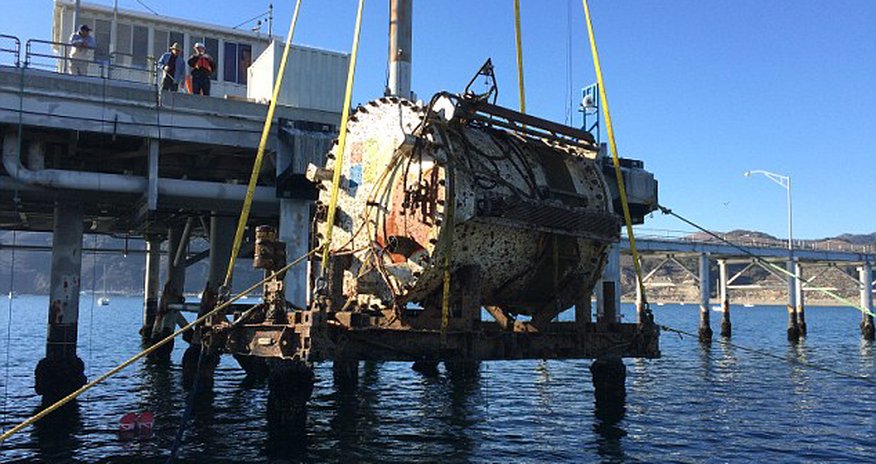
The test, named Project Natick, took 105-days and involved placing a steel capsule — eight feet in diameter —30 feet underwater in the Pacific Ocean near the coast of San Luis Obispo.
Microsoft placed 100 different sensors on the capsule to measure pressure, humidity, motion and other conditions in the case of leaks.
It consumed computing power equivalent to 300 desktop PCs and Microsoft researchers claim it was the first time a datacenter has been placed below the ocean's surface
The capsule held up and engineers were even able to run commercial data-processing projects from Microsoft's Azure cloud computing service.
Microsoft has now started designing an underwater data center that will be four times the size of the current prototype.
The technology to put sealed vessels underwater with computers inside isn't new.
But it was only when one of Microsoft's employees, who had experience serving on submarines that carry sophisticated equipment, that the company came up with the project.
The company claims going under water could solve several problems.
Cooling is an important aspect of datacenters, which normally run up substantial costs operating chiller plants and the like to keep the computers inside from overheating.
The cold environment of the deep seas automatically makes data centers less costly and more energy efficient.
Using the hydrokinetic energy from waves or tides for computing power could also make centers more energy efficient.
This means datacenters could work independently of existing energy sources, located closer to coastal cities, powered by renewable ocean energy.
Placing computing power near users lowers the delay people experience when using the internet, which means faster browsing and download speeds.
Half of the world's population lives within 120 miles of the sea, which makes it an appealing option.
'We're a small group, and we look at moonshot projects,' Norm Whitaker, who heads special projects for Microsoft Research Next.
The paper came out of ThinkWeek, an event that encourages employees to share ideas that could be transformative to the company.
'As we started exploring the space, it started to make more and more sense. We had a mind-bending challenge, but also a chance to push boundaries.'
One of the paper's authors, Sean James, had served in the Navy for three years on submarines.
'I had no idea how receptive people would be to the idea. It's blown me away,' said James, who has worked on Microsoft datacenters for the past 15 years.
'What helped me bridge the gap between datacenters and underwater is that I'd seen how you can put sophisticated electronics under water, and keep it shielded from salt water.
'It goes through a very rigorous testing and design process. So I knew there was a way to do that.'
Drawing from the submarine example, they chose a round container.
'Nature attacks edges and sharp angles, and it's the best shape for resisting pressure,' Cutler says.
This project showed it's possible to deploy datacenters faster. Building the vessel that housed the experimental datacenter only took 90 days.
'The bottom line is that in one day this thing was deployed, hooked up and running. Then everyone is back here, controlling it remotely,' Whitaker says.
'A wild ocean adventure turned out to be a regular day at the office.'
The team is still studying data from the experiment, but so far, the results are promising.
The team is currently planning the project's next phase, which could include a vessel four times the size of the current container with as much as 20 times the compute power.
They are also evaluating test sites for the vessel, which could be in the water for at least a year, deployed with a renewable ocean energy source.
(http://www.dailymail.co.uk/sciencetech/article-3426977/The-internet-set-UNDERWATER-Microsoft-reveals-seabed-server-says-eco-friendly.html)
www.ann.az


Instagram
Follow us on Instagram
Similar news
Similar news












 Photo




 Video


