





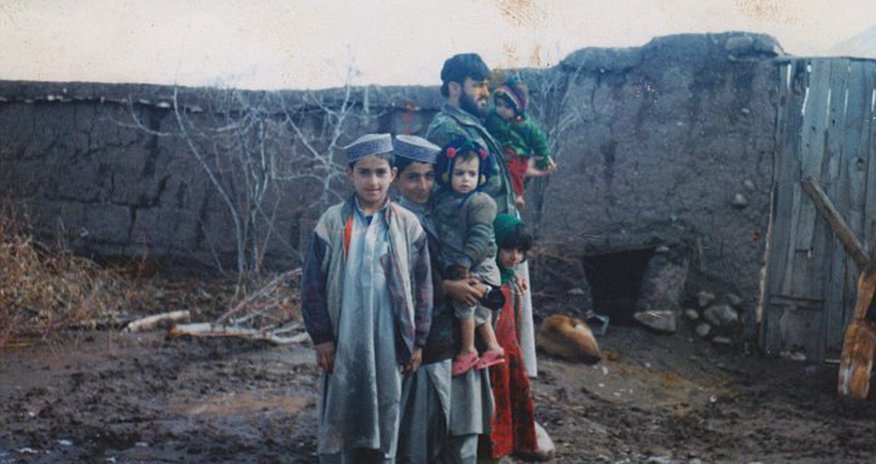
The Taliban 10-year-old who ran for his life... all the way to the Olympics
29.05.2020 03:01


At the age of 17, more than six years after I had tearfully said goodbye to my mother in Waziristan, I stood in Burnley Town Hall. I, the once-scrawny refugee who had left Afghanistan to avoid being becoming a Taliban suicide bomber, had been selected to help carry the 2012 Olympic torch through Britain ahead of the London Olympic Games. The streets were lined with people cheering and waving flags. At that moment, I don’t think I could have loved my adopted country more. I kissed the torch and beamed with pride.
At so many times on my journey to freedom I had felt hopeless, despondent and afraid: when I was shot at in Iran, tortured in a Turkish police station, nearly drowned crossing the Mediterranean, and living in squalor in migrant camps near Calais.
Many times I considered giving up and going home. But at those moments of weakness one thought kept me going: my mother sent me away to save my life. As I ran through the streets of my adopted home, the torch burning brightly and with people cheering, I thought only of one thing – her. At that moment I knew, beyond all doubt, that I hadn’t failed her. I had made it.
I was seven years old. I remember running between the kitchen and the guesthouse, my mother handing me pots of tea to take to the tribal elders and Taliban fighters who had amassed in our home.
A Saudi man called Bin Laden, who my Uncle Lala told me was a great freedom fighter, had attacked America. Now, just days afterwards, the US was angry with Afghanistan, blaming us for it. This was because the Taliban was refusing to bow to American pressure and hand over Bin Laden, who was said to be sheltering in Tora Bora, a couple of hours’ drive from where we lived.
When the US began to bomb Tora Bora, we could hear the sound, but it was far enough away for us not to be at direct risk. Shortly afterwards, however, bombs rained from the sky directly overhead.
It was only later that I learned that the area around our home had been the last front line; Uncle Lala had been one of the last local commanders of the Taliban to hold his position against the US-led coalition forces.
Soon after that final battle, he fled the country himself, and we didn’t know where he had gone.
Three years after the US occupation began, my father, a doctor, was shot by US troops. Taliban representatives began to visit our home. They wanted my brother and me to become fighters or even suicide bombers – martyrs – to avenge our father’s death. I wanted to do it. But my mother was influenced by a different set of thinking – her deep and abiding faith. She had a genuine and strong understanding of true Islamic law, and it is a religion that prohibits the taking of life.
My mother was also doubly scared for me and my elder brother Hazrat, because the US forces were urging us to become informants. She feared that if we got involved with Nato forces, we would be seen as traitors and killed – so she hatched a plan to get us out. Never did I imagine that her plan would involve paying people smugglers thousands of dollars to take us to Europe.
First, when I was ten, she sent us to stay with my aunt in Waziristan. Then, one night she arrived and told us that we were to be taken ‘to safety. To Europe’. I will never forget her parting words: ‘You must hold on to each other’s hands. Never let go of each other. This is for your own good. However bad it gets, don’t come back.’
The man who took us from her made light of our grief at parting. ‘They will be there in a few weeks,’ he assured my mother. ‘It will be like a holiday, an adventure.’ His words couldn’t have been further from the truth.
The next morning we were handed over to a man and a woman. The woman explained that they would fly with us to Iran. At the airport, we were to make no noise and not attract the attention of security guards. From there we would go to Europe.
On arrival at Peshawar’s international airport, over the border in Pakistan, the man we were with picked up Hazrat’s bag and led him through the gate. I went to follow, but the woman held me back. I wanted to yell his name but the woman’s earlier warnings about not attracting attention still loomed large in my mind. ‘I want to go with him,’ I whispered.
I started to cry and she looked around nervously. ‘Later. You will see him on the plane.’ I stopped crying because I believed her. But when we boarded the plane, my brother was nowhere to be seen. I would not see him again for more than a year.
I flew to the city of Mashhad in Iran and so began the rough and terrifying 12-month odyssey which saw me criss-cross Iran, Turkey and Bulgaria in search of safe passage to Western Europe.
It led me near death, jumping from a moving train in Bulgaria, and to torture at the hands of the police in Istanbul. I escaped from a prison bus in Iran, was shot at by the police, and drifted for days on a stricken boat in the Mediterranean.
I was taken to hospital after climbing into a lorry full of toxic chemicals and, on my arrival in Greece, sentenced to three months in jail, where I woke the cell block at night with my screaming.
Hustled roughly by smugglers from buses to pick-up trucks and cattle wagons, without questioning or really even thinking, I put my life into the hands of strangers again and again. I often travelled on foot for days and nights on end, walking through the dark in remote, dangerous mountainous regions to avoid detection.
Accommodation was at best crowded, and at worst vile: at one stop in Turkey I was herded into a hen coop crowded with migrants and told: ‘Welcome to hell.’
My journey nearly killed me, and it left mental, physical and emotional scars that I will bear for the rest of my life. When I think back to that extraordinary time, I am reminded time and again how lucky I am to have made it out alive. At times along the way I would tearfully question why my mother had forced me to go away. But I would remind myself that she had done it for me, for my safety, and that would drive me on. Besides, Hazrat was still out there somewhere, and I had to find him. I clung on to that thought with grim determination.
Since we had been separated in Peshawar, I had heard no news of him, but had never given up hope. Finally, in Greece I met a smuggler’s agent who had come across him. Hazrat, I was told, was on his way to England, so that’s where I must go. But first I had to negotiate the hell on Earth known as the ‘Jungle’ in Calais.
I reached Calais in the company of another Afghan, Jan. We walked for many miles towards the port area. All I could smell was human decay, and the diesel fumes from the stream of double-trailer lorries that crawled past us. On our arrival at the Jungle, the people who were guiding us took us to a spot where several migrants sat huddled around a fire. A muscular man appeared. ‘Gulwali, this is Karwan.’ We shook hands.
‘You are the newcomers. I am told you want to get to England.’
‘Yes,’ I said.
‘Pay me €300 each.’
‘That is too much. We don’t have that much money. I can give you €50,’ I said, taking a note from my pocket. I had another €50 in there too, but I was determined not to let him see it.
‘Don’t waste my time with €50.’
‘Please, Karwan. You’ve got to help us. Please.’ I looked up into his eyes. I was getting to him. He muttered something I didn’t catch. He repeated himself: ‘So, what about the €50 you still have hidden in your pocket?’ He’d seen it. Reluctantly I gave him the money.
‘All right, I’ll take you,’ he huffed.
I was face-down in the freezing mud, scrambling beneath a gap in a wire-mesh security fence. Through the sleet I could make out dozens of figures swarming around the backs of the high-sided trailers. ‘Come on,’ said Karwan. ‘Check underneath.
They are good spots.’ I had looked under one trailer before a hand caught my shoulder. It was a Pakistani man. ‘Don’t listen to him, boy,’ he said in Pashtu. ‘It’s too cold to ride underneath. If you don’t freeze to death, you’ll lose your grip and get crushed. Better to ride in the back.’
But as we searched, it became clear that there were simply too many people for the few hiding places. ‘Let’s go,’ said Karwan. ‘I have a better plan.’ Two hours later, Jan and I sat shivering back-to-back beneath a concrete motorway bridge. Karwan had gone on to make ‘other arrangements’. He returned soon after, brandishing heavy grey bolt-cutters. ‘The keys to England, gentlemen,’ he said.
He cut our way into another parking area. This one was a marshalling place for what Karwan told us was British-bound ferry traffic. Night was giving way to day now, and I could feel desperation rising inside me. Coming to a decision, Jan and I ran across the open car park. We crouched beneath the tail of a lorry.
‘There!’ Karwan suddenly pointed towards a silver estate car parked to one side. The driver’s door was open and we could make out a figure standing against the fence, steam billowing from around his feet as he peed. Jan opened the back door.
I slid into the tight space, crawling into the hole behind the driver’s seat in an effort to make room for Jan. He squeezed in behind me and I heard the door click shut.
(dailymail.co.uk)
www.ann.az


Telegram
Follow us on Telegram


Similar news
Similar news

World 12:30
Iran Urges Middle East Nations to Reject US Military Support, Warns of Retaliatory Strikes











 Photo




 Video


