





Is Putin motivated by Russia's weakness?
14.10.2015 22:30


Russia's intervention in Syria caught the world by surprise. Moscow gave Washington just one hour's notice before it began its aerial bombardment.
It is the first time President Putin has deployed force beyond the borders of the former USSR and another dramatic step in his increasingly assertive foreign policy.
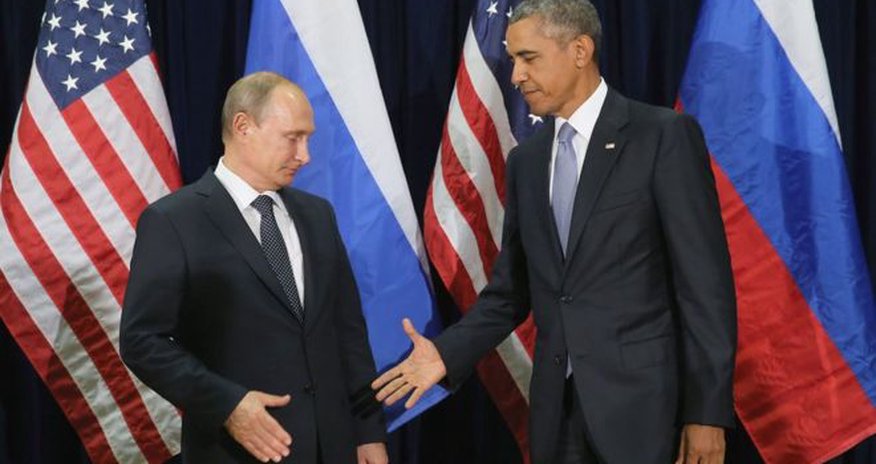
But President Obama's press secretary has described Russia's action as motivated by "weakness", not strength. Is he right?
Four experts discuss Putin's tactics with the BBC World Service Inquiry programme.
William Courtney: Moscow is weak
US Diplomat William Courtney first worked in Moscow 30 years ago. He was the US Ambassador in Kazakhstan and Georgia and a special adviser to President Clinton on Russia. He is now an Adjunct Senior Fellow at the RAND Corporation.
"Russia's actions are motivated by weakness.
"Moscow has traditionally counted on Syria, Iraq, Iran and Libya, but in recent years the west has taken out Gaddafi and Saddam, and now with the Iran nuclear agreement, the Russians have less expectation about the future of their special relationship.
"So in the Middle East, of the four traditional allies, Bashar al-Assad is the last one.
"Because Russia sees itself as a great power, but its eroding influence in the Middle East challenges that concept, the Kremlin made a bold decision to try to help strengthen the Bashar al-Assad government.
"Way back in Russia in history, back in the Tzarist period, the concept that Russia was a great power was very important to the political culture. A lot of Russians were willing to sacrifice their own personal betterment so that Russia could be a stronger power.
"The Middle East is the last place where Russia can play a great power role beyond its neighbourhood."
Andrei Kolesnikov: Russia is an economic mess
Andrei Kolesnikov is a former Russian journalist who runs the domestic politics programme at the Carnegie Centre think tank in Moscow.
"On the one hand, Russia is quite strong: a big country with very big resources. On the other hand this country is extremely weak: declining living standards, weaker economic growth. It depends on the price of oil and gas. And the source of today's problems is oil.
"Inflation is at 15%, quite high even for Russia; and I can't see any signs of resurrecting competition between small and middle-sized businesses.
"The working age population is deteriorating, and there are some predictions that in 2030 we will have one pensioner [for every] one working person. Demography may be the main source of deteriorating of Russian economy in the long-term perspective.
"We have a lot of people who are dying young because of external reasons, for example accidents on the road, or from drinking. This is not typical for countries which are in a good shape.
"Putin offered people some kind of social contract: Crimea in exchange for freedoms. Now he is trying to articulate the addition to this contract: the Syria conflict in exchange for freedoms.
"For the moment, this social contract is working. But after the next presidential elections of 2018, I can't predict what he will invent in order to maintain the level of his popularity.
"I can't find any sign of strategic thinking."
Alexander Korolev: It's all about China
Born in Irkutsk, Alexander Korolev is now a research fellow at the National University of Singapore.
"There is a kind of new politics emerging, where Putin's ideal greater Europe - from Lisbon to Vladivostok - is being replaced by greater Asia - from Shanghai to St Petersburg.
"In 2013/2014, two huge energy deals were signed between China and Russia. And, also, what is more important is that Beijing is actually receiving access to Russia's oil and gas fields.
Even in the areas of competing interests, for example, in Central Asia where China's and Russia's interests clash, recently Moscow and Beijing agreed to cooperate through its 'One Belt One Road' plan.
"In May 2015, the Russian and Chinese navies conducted their first naval exercise in the Mediterranean, which is considered sort of the heart of Nato and this is very new. It never existed before.
"China gives Russia what Russia wants: if you look at the United Nations Security Council, you will see that China and Russia jointly vetoed a US-backed resolution on Syria, four resolutions in a row.
"China never took an anti-Russia stance after the Russia/Georgia war in 2008 or during the ongoing Ukraine crisis, so it's a sort of tacit agreement or informal alignment, if you like, between the two countries, and it's a very important one because both are powerful countries."
Hannah Thornburn: A decisive Putin demands respect
Hannah Thornburn focuses on Eastern European politics at the Hudson Institute think tank in Washington DC.
"I look at it as opportunism. You've seen indecisiveness from both the US and our transatlantic allies. Europe's been in a very difficult position for the last two years. You've seen the United States walk back from its involvement in Syria. The 'red line' on chemical weapons was passed and then nothing was done about it.
"The very fact that Vladimir Putin has the gumption to make this kind of a decision builds him up in a way that is very beneficial to his goals. People gravitate towards a decisive leader, even if, in retrospect those decisions may be wrong.
"Over the past weeks, you've seen Israeli Prime Minister Netanyahu, Turkish President Erdogan and Iranian leader Qasem Soleimani all flying up to Moscow. Putin and the Kremlin have essentially attempted to rewrite the social contract that they have with the Russian people.
"Ten years ago the idea was 'look, you give me reasonably free reign to do as I see fit in this country, and you're going to see your standard of living rise.'
"But now he's saying: 'The other thing that we want is to see a great Russia on the scene again. No longer will we be humiliated in the international sphere. But to do that I'm going to ask you to give up a little bit of the financial gain that you've gotten over the past ten to 15 years for the greater good; for the greatness of Russia.'
"And to my mind, I think that's working."
(BBC)
www.ann.az


Telegram
Follow us on Telegram


Similar news
Similar news

World 12:30
Iran Urges Middle East Nations to Reject US Military Support, Warns of Retaliatory Strikes











 Photo




 Video


