





Syrian woman gives birth on beach on Greek island of Lesbos
14.10.2015 22:00


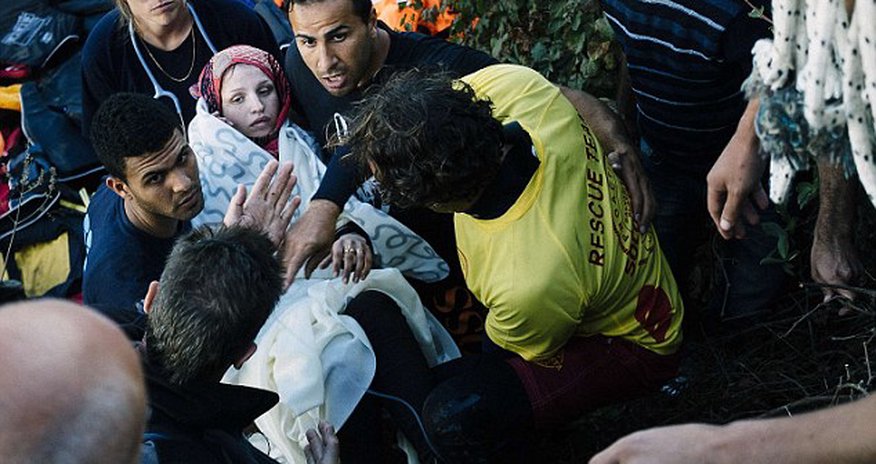
Frail and ashen-faced, a young Syrian woman is wrapped in blankets moments after giving birth on the Greek island of Lesbos.
The woman had her baby shortly after landing on the beach after crossing the Aegean Sea from Turkey.
Paramedics and volunteers treated the new mother on the shore before carrying her inland. She is understood to be among a group of migrants who arrived on the island by rubber dinghy today.
It comes days after the Greek government announced its first so-called 'hotspot reception centre', which will register and identify migrants, would open on the island within the next 10 days.
Four further centres, on the islands of Kos, Chios, Leros and Samos, are to start opening within a month as the nation continues to struggle to cope with the massive influx in migrants.
European Union officials say the centres will allow migrants and refugees to be flown to other EU countries - mostly of their choosing - and have their asylum applications reviewed there.
Greece has seen a record of about 400,000 refugees and migrants - mainly from Syria, Afghanistan and Iraq - arrive this year from nearby Turkey, as they hope to reach wealthier northern Europe.
But it has struggled to cope with the numbers both in terms of registering the refugees and looking after them while they are in the country, with its economy depleted by six years of financial crisis.
Aegean Sea islands closest to Turkey reached breaking point this summer, overwhelmed by the number of arrivals.
Registration was lengthy, and many ended up sleeping rough in the street as they lacked the facilities to house them.
Those who can afford it move on quickly to other countries, sometimes on tour buses taking them straight from the main port of Piraeus, near Athens, to the Macedonian border.
But several thousand, mostly Afghans, have ended up trapped in Greece for lack of money.
With the new processing centres, Greece hopes to relocate about 10,000 people every two months, or 70,000 in a year, Migration Minister Yannis Mouzalas said.
It has also committed to creating two centres for up to 10,000 people in total, rather than ones with a capacity of 15,000 people as was feared, in order to avoid 'turning the country into a refugee camp,' Mr Mouzalas said.
(dailymail.co.uk)
www.ann.az


Instagram
Follow us on Instagram
Similar news
Similar news
World 12:30
Iran Urges Middle East Nations to Reject US Military Support, Warns of Retaliatory Strikes



 Photo




 Video


