





Sinai plane crash: Four theories
03.11.2015 20:30


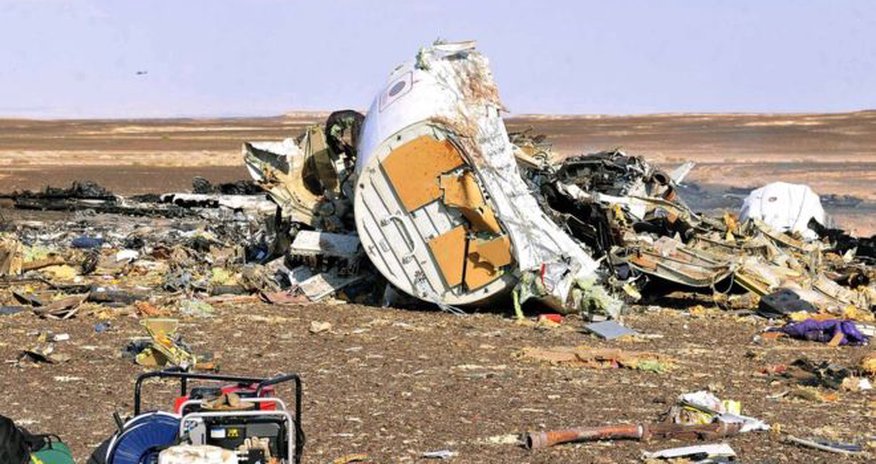
Egyptian and international experts have begun their investigation into why a Russian airliner carrying 224 people crashed in the north of Egypt's Sinai Peninsula, killing all on board.
What will be their main lines of inquiry?
Technical fault?
Egypt's prime minister has said a technical fault was the most likely cause of the disaster, but that it would be up to the air accident investigators "to prove or deny this".
Egypt's civil aviation minister Hossam Kamal said there had been no sign of any problems on board the flight, contradicting earlier reports that the pilot had asked to make an emergency landing after experiencing technical problems.
In Russia, the widow of the plane's co-pilot, Sergei Trukhachev, told NTV her husband had complained the plane's condition "left much to be desired" during a telephone call before the flight left Sharm el-Sheikh.
But the Kogalymavia airline has insisted the 18-year-old plane was fully airworthy, and Mr Kamal said that "there were no reports that the airplane had faults, the checks done before take-off did not reveal anything".
Kogalymavia has said "external factors" were behind the crash - meaning the airline believes it was not a technical fault.
According to the Aviation Safety Network, the plane sustained a tail strike - when a plane's tail hits the runway - while landing in Cairo in 2001. That took three months to repair.
The botched repair of a tail strike caused Japan Airlines Flight 123 to crash in 1985, the worst single-aircraft accident in history, in which 520 of 524 on board were killed.
But Kogalymavia officials said that the plane was repaired completely after the 2001 incident, and this could not have had an effect on its safety.
Human error?
The airline has said that the pilot - who reports identified as Valery Nemov - had more than 12,000 hours of flying experience, including 3,860 hours in A321s. Kogalymavia says it has ruled out "any mistake by the crew."
But the aircraft's "black boxes" - the cockpit voice recorder (CVR) and the flight data recorder (FDR), both of which have been found - will provide investigators with detail on the last minutes of the flight and tell them whether any actions taken by the flight crew caused or contributed to the crash - which happened during fine weather.
Officials have reportedly said that the "black boxes" are in good condition.
The CVR records the voices of the pilots and other sounds from the cockpit. It retains two hours of recording - on longer flights, the latest data is recorded over the oldest.
The FDR records technical flight data, including at least five basic sets of information: pressure altitude, air speed, heading, acceleration and microphone keying (the time radio transmissions were made by the crew).
Both recorders are designed to withstand a massive impact and a fire reaching temperatures of up to 1,100C for 60 minutes.
Security experts have poured scorn on claims from jihadis allied to the Islamic State (IS) group, who are active in the Sinai area, that they downed Flight KGL9268, but examinations of the aircraft wreckage and debris field will enable investigators to definitively pronounce on this theory.
A senior Russian aviation official has confirmed that the plane broke up in mid-air. But Viktor Sorochenko said it was too early to draw conclusions about the causes of the disaster from that fact.
The jet was cruising well above the maximum range of any surface-to-air missile that the jihadists are thought to possess. These are far less powerful than the vehicle-borne Buk system that shot down Malaysia Airlines flight MH17 over Ukraine last year.
Experts have also questioned the logic of why Islamic State's Sinai affiliate would risk inviting a massive international retaliation by such an action when its battle is primarily with the Egyptian state.
BBC security correspondent Frank Gardner says that with Russia fighting a war against IS in Syria, and Egypt's fragile economy in desperate need of tourists, both countries will be hoping this has nothing to do with terrorism.
(BBC)
www.ann.az


Telegram
Follow us on Telegram


Similar news
Similar news

World 12:30
Iran Urges Middle East Nations to Reject US Military Support, Warns of Retaliatory Strikes











 Photo




 Video


