





Russian plane crashed at what should have been flight's safest point
04.11.2015 11:00


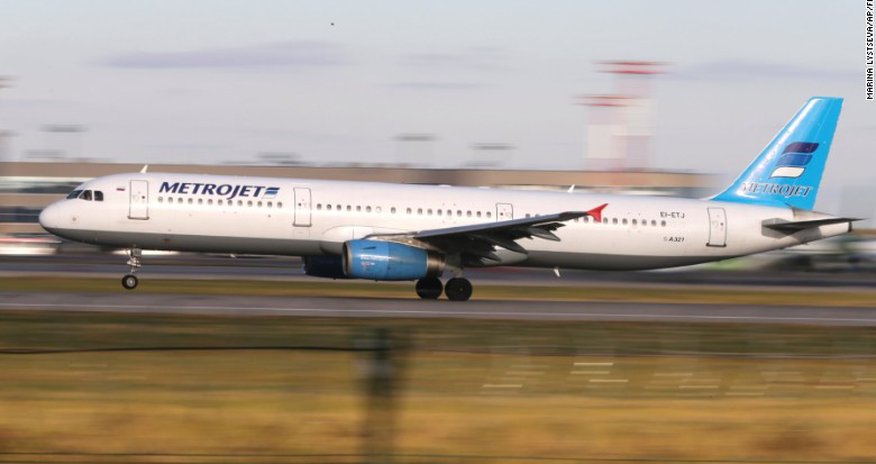
The Russian aircraft that went down Saturday in Egypt's Sinai Peninsula crashed in what was the safest part of its flight from Sharm el-Sheikh to St. Petersburg, Russia.
The plane had been in the air for roughly 23 minutes. At this point, a plane is on autopilot. It's reaching its initial cruising altitude, and there is little that can or should go wrong.
If you look at statistics, most accidents happen on takeoff or landing -- far and away, most are on landing, more than 50%. A small proportion -- roughly 10% -- happen in the phase of flight known as the "cruise," which is where this plane was.
For something to happen at that point in the journey to bring down an aircraft is unusual.
If it hasn't been blown out of the sky by terrorist or military activity -- and there's no evidence of that in this case so far -- then it should be the safest part of the flight.
The aircraft had already reached an altitude of about 33,000 feet and was just flying along.
Looking at the numbers, its rate of descent is dramatic and variable; it goes on for some seconds before the plane succumbs.
But whatever happened was dramatic enough it made the plane uncontrollable or it became uncontrollable and stalled because of the way it was being flown.
There are reports that some eyewitnesses may have seen flames from an engine. Eyewitnesses are notoriously unreliable in these situations, but if there's an engine fire, there are procedures that take place. As we know from numerous cases, an engine failing -- even blowing up in flight -- does not cause the destruction of the aircraft.
If something does go wrong and it is significant, then you are looking at how the pilots are flying this extremely sophisticated aircraft -- the Airbus A320 family is highly computerized, it has multiple systems of great complexity, and requires an extremely sophisticated level of flying.
This particular aircraft is 18 to 19 years old, but there are many aircraft flying around the United States that are as old, if not older, so the age of the aircraft shouldn't be a concern -- as long as it has been properly maintained and the crew properly trained. Looking at those two aspects will be crucial in this investigation.
Russia has had a safety problem, post-Soviet Union; there's been a fast expansion of airlines, many new carriers, and the country has had some difficulties with safety.
It has had more accidents than Western Europe or the United States. According to the latest International Air Transport Association report for 2014, there's one accident per 1 million flights in the United States; in Europe, the rate is 1.35, but in Russia and the Commonwealth of Independent States, it is 2.19 -- more than double the U.S. figure -- though it is still favorable compared with, say, Africa, which has 11.18.
Russia has a fast-growing aviation sector with many modern aircraft, and there may be a question of training and infrastructure not keeping up with the pace of growth -- we've seen it in Asia also.
When it comes to the investigation and finding out what happened and who was responsible, we have a real mess on our hands.
The airline, Metrojet, is Russian, so the "state of operator," to use the technical term, is Russia. That means the Russian authorities are responsible for providing information about what happened.
The rules say that the investigation falls to the "state of occurrence," where the accident took place -- in this case, Egypt. The country will be responsible for investigating unless it decides to delegate that authority to Russia.
And on top of this, you also have the "state of manufacture" at the table -- the plane's maker was Airbus, so it has input in the process, as does whoever made the engines.
But honestly, I don't think this is going to be a difficult investigation.
Once they have located and recovered the so-called "black box" recorders -- the cockpit voice recorder and the flight data recorder -- they will know exactly what took place, what failures took place at 33,000 feet and how the pilots responded to that emergency.
I think what they'll find is an extremely complicated series of events, but it will ultimately come down to how the plane was being flown as a result of them.
(CNN)
www.ann.az


Instagram
Follow us on Instagram
Similar news
Similar news

World 12:30
Iran Urges Middle East Nations to Reject US Military Support, Warns of Retaliatory Strikes











 Photo




 Video


