





Four zeros off currency prime Belarus for economic makeover
19.11.2015 09:30


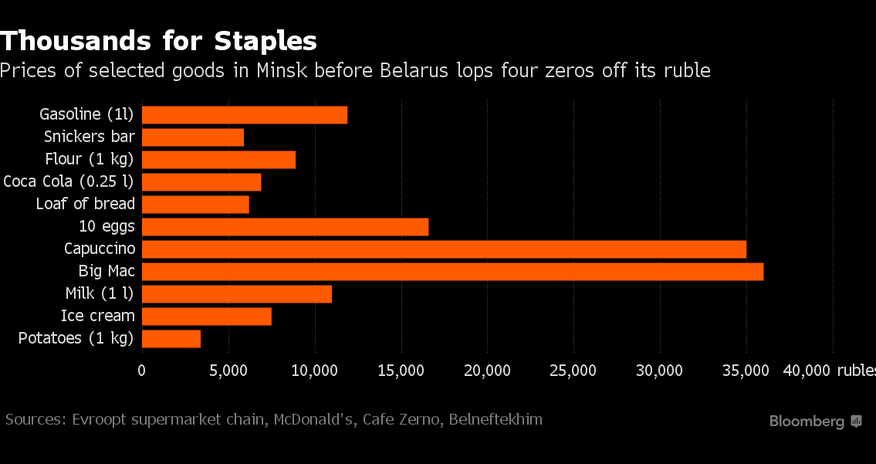
President Alexander Lukashenko’s third currency re-denomination in Belarus may be about more than doing away with the inconvenience of having to pay tens of thousands for a burger.
Europe’s longest-serving leader is turning his sights on inflation by lopping off another four zeros off the ruble next year, bringing the face value of the new money to one hundred-millionth of what it was worth before the first move in 1994.
With Lukashenko looking to raise capital from Western investors and financial institutions, the overhaul is also a nod to demands from the International Monetary Fund, which last week kicked off talks on a new loan with Belarus.
Former Soviet nations from Kazakhstan to Azerbaijan are battling the effects of the recession and currency crisis in Russia, the region’s biggest economy that accounts for about half of Belarus’s total trade. With the re-denomination, Lukashenko is sending the strongest signal yet that he is rebooting an economy still recovering from a spike in inflation to more than 100 percent three years ago. Belarus is trying to follow in the footsteps of neighbors like Poland, where inflation expectations plunged in half soon after its currency overhaul in 1995.
"This year has undoubtedly become a turning point for the Belarusian economy,” said Sierz Naurodski, president of research center CASE Belarus in Poland. "The central bank has finally shifted its policy from propping up the ruble’s exchange rate to regulating its monetary base, which may help to stem inflation.”
The nation is unveiling the plans after its assets have rallied as tensions eased in Ukraine, cutting the premium on Belarus’s debt to the lowest in almost a year compared with other emerging markets. Since a cease-fire in eastern Ukraine was negotiated in February, the Belarusian government’s January 2018 dollar bonds have surged more than 30 percent.
The steepest re-denomination in the country’s modern history was announced less than a month after Lukashenko’s re-election to a fifth term.
Romania, Zimbabwe
It follows developing nations from Romania to Zimbabwe, which have lopped zeros off their currencies about 70 times since the 1960s, often using the move to try to vanquish inflation or win back confidence in their currencies at times of economic upheaval.
Polish central bank Governor Marek Belka, who advised the monetary authority when the zloty was re-denominated two decades ago, said in 2010 that the move "stabilized expectations for prices and expectations for a stable currency.” That success, though, was only possible because it was accompanied by other measures, he said.
The Belarusian leader, in power since 1994, has moved gingerly to reshape an economy reliant on its exports of potash and refined oil products. Unwieldy state-run companies still loom large, employing hundreds of thousands of workers and churning out products from mining dump trucks to refrigerators.
New Priorities?
The government has overhauled its priorities, putting an "unconditional” repayment of foreign debt at the top of the list, alongside stemming inflation and increasing productivity, First Deputy Economy Minister Aleksander Zaborovskiy said during a parliamentary hearing in the capital, Minsk, on Wednesday. Boosting economic growth isn’t the main item on the agenda, with Belarus expecting the country’s gross domestic product to grow only 0.3 percent next year, he said.
The government will also seek either to restructure or liquidate more than 400 struggling state-owned companies rather than trying to keep them afloat, according to Zaborovskiy. Directed lending programs will be reduced in the future and businesses will have to increasingly rely on commercial loans, he said.
The government’s social and economic forecasts are "not one iota different” from what will be set out in the IMF’s new program, he said.
The currency reorganization may signal that Lukashenko is pivoting to focus less on pumping money into the economy, a policy that’s depleted reserves to the lowest in four years, according to Naurodski.
Single Digits
While the central bank said the measure is focused on streamlining money circulation and accounting, Lukashenko wants to bring inflation into single digits. Consumer-price growth, which slipped to 11.5 percent from a year earlier in October, was last less than 10 percent in February 2011.
The central bank this year loosened its control over the currency and adopted a base-money targeting framework urged by the IMF. The Washington-based lender, which is negotiating a new three-year loan program for Belarus, earlier blamed the country’s vulnerability to economic shocks on the failure of the nation’s "over-determined central-planning model to deliver sustainable growth.”
(Bloomberg)
www.ann.az


Telegram
Follow us on Telegram


Similar news
Similar news

World 12:30
Iran Urges Middle East Nations to Reject US Military Support, Warns of Retaliatory Strikes











 Photo




 Video


