





Charles de Gaulle heads to war
19.11.2015 13:30


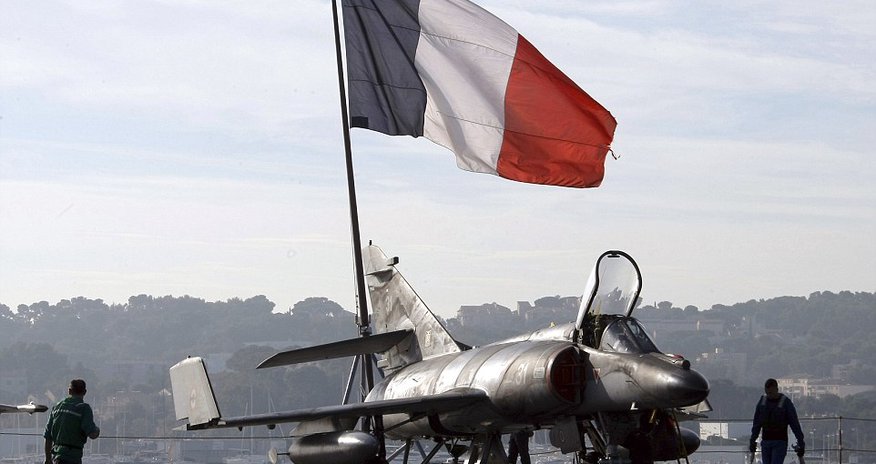
France is sending its biggest warship to the Middle East after it pummelled ISIS's Raqqa stronghold in a joint bombing campaign with Russia.
Air strikes in Syria have killed at least 33 ISIS terrorists in three-days of attacks in northern Syria, it has emerged.
The death toll was revealed as France sent the aircraft carrier Charles de Gaulle, from its base in Toulon, southern France, to the Middle East to support the mission.
Dozens of jihadists have also been wounded in bombing raids which targeted weapons depots, barracks and checkpoints in the ISIS stronghold of Raqqa.
Dramatic images of footage of first French and then Russian airstrikes showed rockets hitting multiple targets. The latest Russian footage showed it targeting an ISIS-held oil-processing facility among other buildings.
France intensified strikes on Raqqa following last week's attacks in Paris that left 129 dead, with warplanes carrying out dozens of attacks on Sunday, Monday and Tuesday.
Russia also pounded Raqqa with long-range bombers and sea-launched missiles on Tuesday, after Moscow confirmed that a bomb attack brought down a Russian passenger jet over Egypt last month, killing all 224 people on board.
Reports have emerged today that ISIS militants are still stiffening their defences for a possible assault on their de facto capital. Fighters are hiding in civilian neighborhoods, preventing anyone from fleeing, former residents say.
The northern Syrian city's estimated 350,000 people are gripped by fear, rattled by powerful Russian and French bombing raids that shake the city daily.
They are also worried they will be trapped with nowhere to go amid signs of a looming ground invasion by U.S.-allied Kurdish and Arab forces in Syria, according to the former residents who have fled to Turkey and now report on events in Raqqa through acquaintances and activists inside.
Raqqa activists say the militants have been stepping up defenses of the city since late October, after the Democratic Forces launched their campaign vowing to retake the city. Shortly afterward, IS banned people leaving the city and activists said it has stepped up enforcement of the ban in the past few days, leading to fears the group intends to use civilians as human shields in future fighting.
To avoid being hit in their bases, the fighters have moved into residential neighborhoods in empty homes abandoned by people who fled Raqqa earlier, said an activist from Raqqa. He spoke on condition he be identified only by the name he uses in his political activism, Khaled, for security reasons.
'There is major fear in the city, especially with Daesh preventing civilians from leaving the city,' Khaled said, using the Arabic acronym for the group.
Khaled, who now lives in Turkey, is in touch with people back in Raqqa. Raqqa residents could not be reached because of an IS ban on private Internet access across the city.
Among new measures that have been put in place by ISIS, according to several of the activists, is an order that IS fighters move only in alleys and side streets to avoid detection from the air and not use vehicles at night.
Those measures have intensified after a series of successful hits by the coalition that killed a number of IS leaders, including Jihadi John who appeared in several videos depicting the beheadings of U.S. and Western hostages.
On the roads leading into Raqqa, the extremists have dug extensive tunnels and trenches, said another activist from Raqqa, who spoke on condition of anonymity for fear of IS retaliation. More recently, the militants placed tires filled with fuel on empty barrels around the city, with plans to ignite them in case of an attack to cloud the skies with smoke.
(dailymail.co.uk)
www.ann.az


Instagram
Follow us on Instagram
Similar news
Similar news

World 12:30
Iran Urges Middle East Nations to Reject US Military Support, Warns of Retaliatory Strikes











 Photo




 Video


