





This is a story about Syria at war
10.12.2015 20:00


Put away the adrenaline and testosterone.
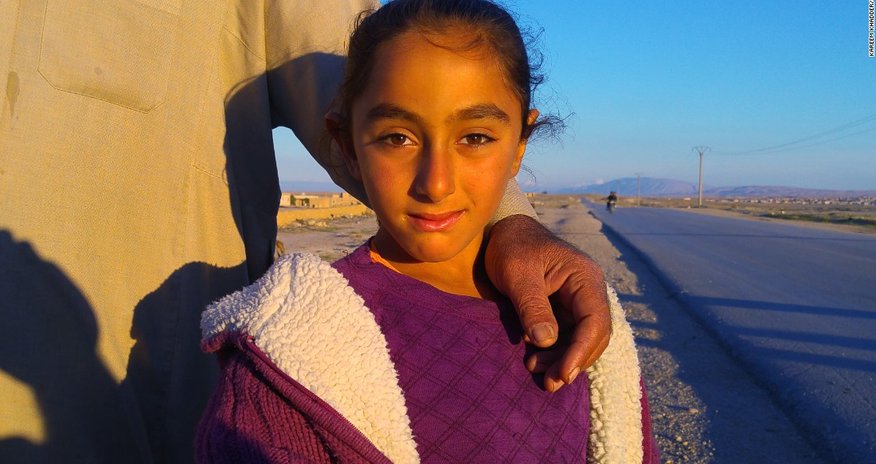
In the six days and five nights we were in northeast Syria we heard not a single shot fired, nor saw a single bomb drop. The flak jackets and helmets we brought with us never left their bags.
We went to a variety of places in northeastern Syria. It involved hours in the car with our drivers, Fahd and Mustafa. Fahd talked and talked and talked and was particularly fascinated with stories about the Arab dictators I had met. He laughed when I told him the only time I had seen Syrian President Bashar Al-Assad in person, at a press conference in 2000 in Cairo with then-President Hosni Mubarak, he seemed awkward, uncomfortable and inexperienced.
Fahd particularly enjoyed listening to my recollections of meeting Saddam Hussein, and interviewing his psychotic, murderous son Udai, who made my blood run cold with his blank, cold stare which said, "I could kill you as easily as I could kill a fly."
Mustafa spent a lot of time talking and singing to himself as he chain-smoked. Both he and Fahd drove with reckless abandon. But despite many close calls on the dark, potholed, bumpy roads, we survived unscathed.
On our first full day we went to the northwestern city of Al-Hassakeh and met with Lewand Rojava, a commander of the Kurdish Peoples' Protection Units (YPG). He is 35 years old and before the war traded in building materials.
Today Rojava commands what is, for all intents and purposes, the most effective force fighting ISIS. He was quick to acknowledge the help of the warplanes of the U.S.-led anti-ISIS coalition, which have been hitting ISIS targets in this part of Syria since last year.
Rojava wouldn't go into detail but told me his forces "coordinate closely at the highest levels" with the coalition -- though he did have a complaint about the material support he and his men had received from the coalition.
"The assistance we've received," he said, "has been ammunition for Kalashnikovs, for heavy machine guns, for mortars, but we haven't received any weapons."
He was coy about reports U.S. Special Forces would soon be deployed in this part of Syria. "You know more than I do," he said unconvincingly.
About an hour's drive to the south of Al-Hassakeh is the town of Al-Houl, recently retaken from ISIS by Kurdish forces. We walked through what was the ISIS "police station" -- a stark affair with a lone overstuffed chair outside. No one had taken the time to paint over the ISIS slogans.
Next to it was the ISIS courthouse, formerly a school. In it we were reminded that ISIS is not just a group of fanatics, it's also a bureaucracy. One announcement we found on the floor called on those living under ISIS rule to hand over whatever they had looted from the city of Mosul, in Iraq, and elsewhere, back to ISIS. Another detailed how much wheat and barley farmers were required to give to ISIS in taxes.
Along the street was a platform, made of rusting steel bars, where those who stepped outside the narrow confines of what was acceptable under ISIS were tied up and whipped.
From Al-Houl we drove a few kilometers south to one of the positions on the front lines. This particular position, on a hilltop overlooking the endless, bleak rolling expanse that stretches all the way to the Euphrates River, was occupied by about a dozen members of the Kurdish women's defense units, the YPK.
I've lived in the Middle East for almost four decades and always thought this part of the globe was a "man's world." This encounter disabused me of this sexist, antiquated illusion.
The women, mostly in their early twenties, were commanded by 21-year-old Telhelden (Kurdish for "revenge"), who was dismissive of the ISIS fighters she and her comrades had driven out of Al-Houl.
"They think they're fighting in the name of Islam," she said. "They believe if someone from Daesh [ISIS] is killed by a girl, a Kurdish girl, they won't go to heaven. They're afraid of girls."
Efelin, 20, giggled when I asked her if ISIS ever tried to approach their position. "If they do," she replied, "we won't leave one of them alive."
Syria: More than a parachute destination
By the way, for me Syria is not just another parachute destination in the contemporary journalist's frenetic world tour that is the war on terror.
My parents lived in Damascus from 1978 to 1981, and although I was in boarding school in Morocco and then in college in the U.S., I visited regularly and had a summer job with a French oil exploration company in the area around the then-obscure town of Al-Raqqa -- which now of course we always preface with the phrase "de facto capital of the so-called Islamic State."
Back then, Raqqa was the big city for me, where on a rare evening off I went with my colleagues -- a collection of French, Syrian, Tunisian and Algerian engineers and technicians -- to guzzle bottle after bottle of bad Syrian beer with Bedouin tribesmen in outdoor cabarets as belly dancers performed. Back then, beer and belly dancers in Raqqa were a naughty distraction, not a religious infraction meriting a flogging, or worse.
My job involved driving around the desert around Raqqa, and south as far as Tadmour -- otherwise known as Palmyra -- also now under ISIS control. Initially I was part of the survey team, which mapped the terrain where other teams later came to conduct seismic tests. We were five in my team -- four Syrians and myself. I lost touch with them but hope they're all still alive.
We were the advance team, laying the groundwork before the heavy machinery arrived. Rather than stay at the base camp (a collection of trailers, tents and workshops), we stayed with Bedouin and farmers. I was later part of one the seismic teams. My job was to rig the dynamite charge for the initial seismic tests. If the soil was rocky, the charge was small, maybe two or three sticks. If the ground was sandy or soft, I would use six or seven sticks of dynamite. I liked the soft soil.
Between 1989 and 1993 I worked at an international agricultural research center in Aleppo. My wife and I, together with our newborn daughter, lived in that beautiful, ancient, complicated, welcoming city. Now, large expanses of Aleppo are a smoldering wasteland of rubble and human bone meal. A city turned into a cemetery.
(CNN)
www.ann.az


Instagram
Follow us on Instagram
Similar news
Similar news

World 12:30
Iran Urges Middle East Nations to Reject US Military Support, Warns of Retaliatory Strikes











 Photo




 Video


