





Is this the first EVER finished Koran?
26.12.2015 09:00


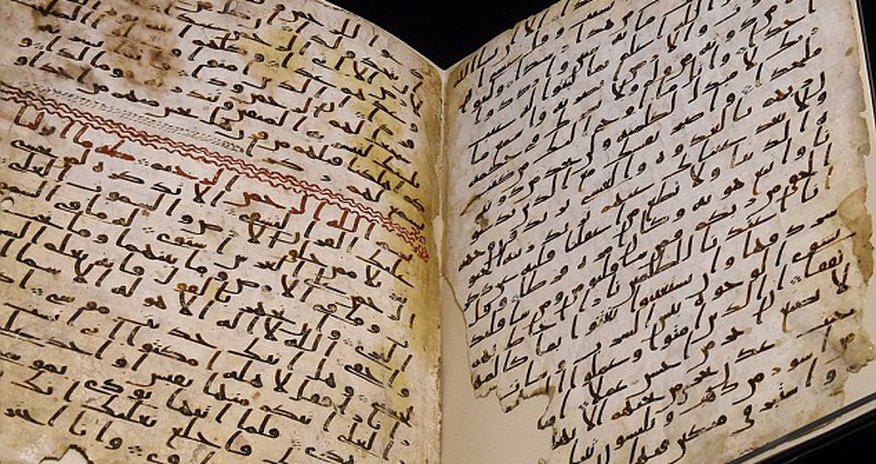
Fragments of the oldest Koran in existence, which were discovered at a British university library, could be from the original copy of the Muslim holy book.
Leading academic Jamal bin Huwareib believes the pages found at Birmingham University earlier this year are from the first assembled Koran by the Prophet Muhammad's close friend Abu Bakr.
The pages, thought to be between 1,448 and 1,371 years old, were discovered bound within the pages of another Koran from the late seventh century at the university's library.
Mr bin Huwareib, who is managing director of the education organisation Mohammed bin Rashid Al Makroum Foundation which was set up the UAE ruler, told the BBC: 'It's the most important discovery ever for the Muslim world. I believe this is the Koran of Abu Bakr.
'This version, this collection, this manuscript is the root of Islam, it's the root of the Koran.
'This will be a revolution in studying Islam.'
Abu Bakr was the first person outside of the Prophet Muhammad's family to convert to Islam in 632AD.
The discovery is thought to be particularly significant as in the early years of Islam, the Koran was thought to have been memorised and passed down orally rather written.
Professor David Thomas, an expert on Christianity and Islam at the University of Birmingham, said earlier this year: 'If it is what we now think it is, is very important indeed.
'Islam is associated, of course, with the Prophet Muhammad, and he lived in the late sixth and early seventh century.
'Now this manuscript could well have been written just after he died.'
'The person who actually wrote it could well have known the Prophet Muhammad.
'He would have seen him probably, he would maybe have heard him preach. He may have known him personally.'
Caliph Abu Bakr became the first leader of the Muslim community after Muhammad's death and ordered the Koranic material to be collected into a book.
The final authoritative written form was not completed until 650AD under the third leader Caliph Uthman.
The pages formed part of the Mingana Collection, which was gathered by Alphonse Mingana, a Chaldean priest born near Mosul in modern day Iraq.
Sponsored by Edward Cadbury, from the chocolate dynasty, he collected 3,000 Middle Eastern documents, which were placed into the care of the University of Birmingham by Cadbury.
(dailymail.co.uk)
www.ann.az


Instagram
Follow us on Instagram
Similar news
Similar news

World 12:30
Iran Urges Middle East Nations to Reject US Military Support, Warns of Retaliatory Strikes











 Photo




 Video


