





Putin unleashes his new secret weapon in the fight against ISIS
05.01.2016 19:00


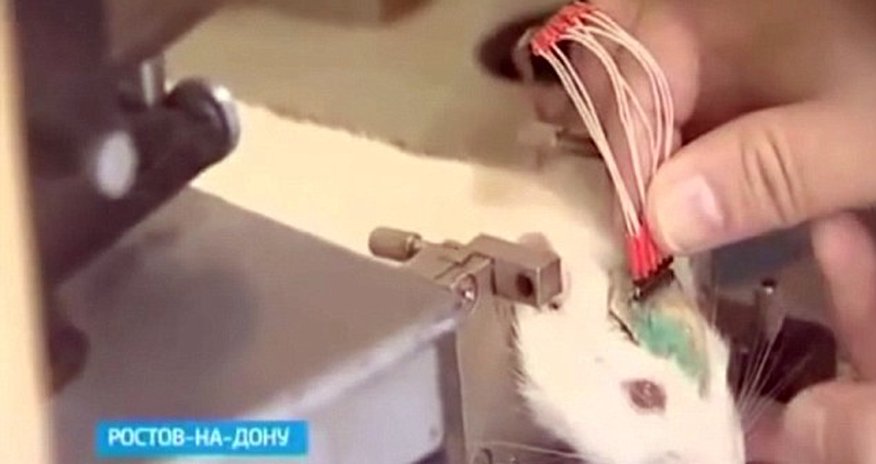
Vladimir Putin is preparing to unleash his latest weapon in the war against terror: an army of cyborg rats.
Russian scientists are hoping to combine the rats and their amazing noses with the latest technology, allowing them to sniff out explosives or drugs in places which are impregnable to all but the very small.
If they are successful, the rodents will be able to alert their handlers to the dangerous or illegal material before they themselves have even had time to register it.
There is only one problem: it takes three months to train a rat properly, and they only live for a year.
This means the scientists would have to 'constantly drill whole battalions of rats to provide security forces with a new type of counter-terrorist operative', according to the Kremlin-backed news agency Sputnik.
But the scientists, from Rostov-on-Don, near the border with Ukraine, are not to be deterred, and are steaming ahead with operation 'Next Generation Warfare'.
Three teams are currently working on the project in the Perception and Recognition Neuro-technologies Laboratory at the South Federal University, hoping to harness rats' raptor neurons, which give the rodents a better sense of smell than artificial devices or even dogs.
Their size gives them the added edge - potentially even allowing them to hunt out survivors following natural disasters.
Dr Dmitry Medvedev, who is heading up the team, said: 'Unlike a dog, a rat can get through the smallest crack where it seems it couldn't go.
'This way it could find its way deep under rubble and by its brain activity one could understand if there are, for example, people who are still alive, if it's worth clearing debris here or at another place, to rescue people more quickly.'
The microchip, which give the rat the appearance of wearing a headdress, should be able to detect the rats' physiological reaction even before the rodent has itself reacted to it.
To do this, programmers are reported to be creating mathematical algorithms to study and understand the results.
These algorithms will help scientists gather data and statistics of the rats' cerebral reactions to various smells.
But before they do this, physiologists have to train the animals to identify explosives and drugs - a difficult task which has to be done in a short space of time.
'Two to three months are needed in order to teach the animal to react to one substance while the life span of a laboratory rat is only about a year, Dr Medvedev admitted, adding: 'We can't use very young rats, and the old ones have already lost their sense of smell.'
(dailymail.co.uk)
www.ann.az


Twitter
Follow us on Twitter

Similar news
Similar news

World 12:30
Iran Urges Middle East Nations to Reject US Military Support, Warns of Retaliatory Strikes











 Photo




 Video


