





The 18-month-old toddler so ill he looks like a newborn
04.02.2016 20:00


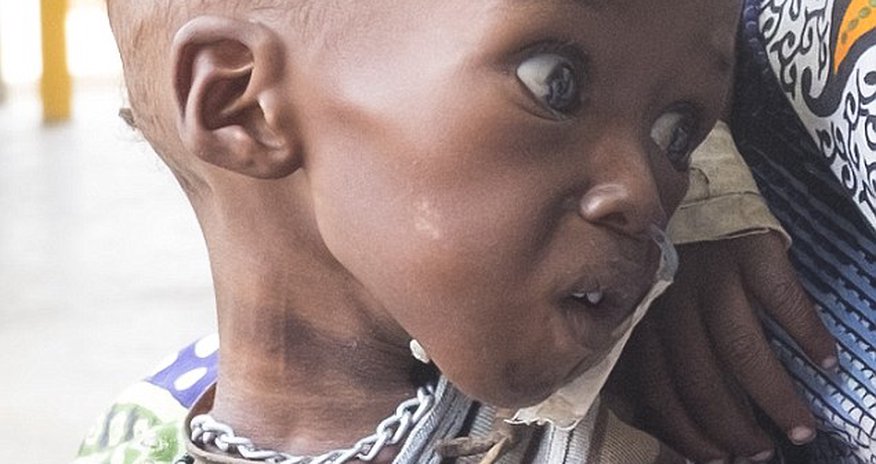
The dark, haunting eyes of one-year-old Nakink Ngasepicho stare blankly at his mother from a gaunt, hollow face.
His skin hangs loosely from tiny bones, a shoulder forms a grotesque nobbled knot while protruding veins clump where hair has fallen out.
He weighs a quarter of what he should and is too exhausted to swat away the flies drawn to his eyes and lips.
Yet doctors say he is one of the ‘lucky ones’ who will survive – at least this time – because he was able to reach Lodwar County Hospital in north western Kenya before it was too late.
When he arrived three days ago in the arms of his mother Nabenyo, 28, he was close to death in the grip of a potentially fatal combination of pneumonia, malaria, anaemia, and diarrhoea.
He was also severely malnourished, leading to a horribly swollen stomach. All are preventable diseases but in the north Kenyan county of Turkana which has the dust-caked ramshackle town of Lodwar at its centre, they are ravaging children in their first years of life.
Shockingly, 122,000 babies and children below the age of five still die each year in Kenya, many of them from preventable diseases – and many of them in Turkana where cyclical drought and climate change has scarred the landscape and lives of its 1.2million population.
Gemma Parkin of the British charity Save the Children, which works across the region, said: ‘At home people will just go to the doctor but sadly here in Turkana preventable diseases can be a death sentence for children.’
MailOnline travelled to the villages at the heart of the crisis to witness the stark realities of life just 360 miles north of the flourishing Kenyan capital Nairobi, to speak to those most affected and to see the work of aid agencies battling to help these nomadic people.
We were told by mothers how every young child in their village had suffered malaria, how some have lost four children to preventable diseases and how the vast majority still give birth at home on rush matting laid out on the baked red earth of their mud-hut homes where the familiar whine of mosquitoes go unnoticed.
Nowhere are the problems more graphically illustrated than in the village of Kaitethe, a bruising hour’s drive from Lodwar through parched, dusty land scarred by dried-up river beds.
Here tragically, babies and young children die routinely from diseases much of the world believes no longer pose a regular threat to life.
In the corner of the small family plot where Tereza and Adome Ekali live with their six sons and one daughter, a mound of baked earth topped with thorns just 10 metres from the door of their small hut marks the spot where four days ago they buried their four-month-old son Epuyo.
As is tradition, they had waited until the blistering sun was setting and for the long shadow of dusk before washing his tiny emaciated body, wrapping it in cloth and then matting before burying it.
‘He died very quickly,’ said Tereza, 35, who has given birth to all her children at home.
‘Epuyo became sick, he had diarrhoea, passing blood, and pneumonia. I did not know what it was and I took him to a clinic here but that night he started to cry…he wouldn’t stop, I kept holding him and I was with him when he died.
‘This is what happens. All the mothers here support one another and feel the pain. Many have lost their children. All have had pneumonia and malaria – it happens here and we cannot help it. There are many, many mosquitoes that live on water and at night are alive in the village.’
‘I did not know until it was too late that the child was ill. Malaria is very strong and we can do nothing about it.’
Much of the hard labour here is done by women, including working on the land, and Mary said she was back in the fields the day after burying her daughter.
In fact, she had been back in those same fields on an oasis of green beside the nearby Turkwel river two days after the home birth.
In a compound where rice is stored, we watched as a woman with a small baby strapped to her back attacked the hard earth with a hoe under a fierce sun while more than a dozen women worked around her.
Three men sat watching and chatting in the shade of an acacia tree.
At another plot in the village where dozens of bare footed children play, it is twin brothers Ngiome and Atukon Kolee that were buried within days of their home birth.
(www.dailymail.co.uk/news/article-3426120/The-18-month-old-toddler-ill-looks-like-newborn-Haunting-images-deadly-toll-curable-disease-Kenya-122-000-infants-die-YEAR.html#ixzz3zBKiEkRB)
www.ann.az


Instagram
Follow us on Instagram
Similar news
Similar news

World 12:30
Iran Urges Middle East Nations to Reject US Military Support, Warns of Retaliatory Strikes











 Photo




 Video


