





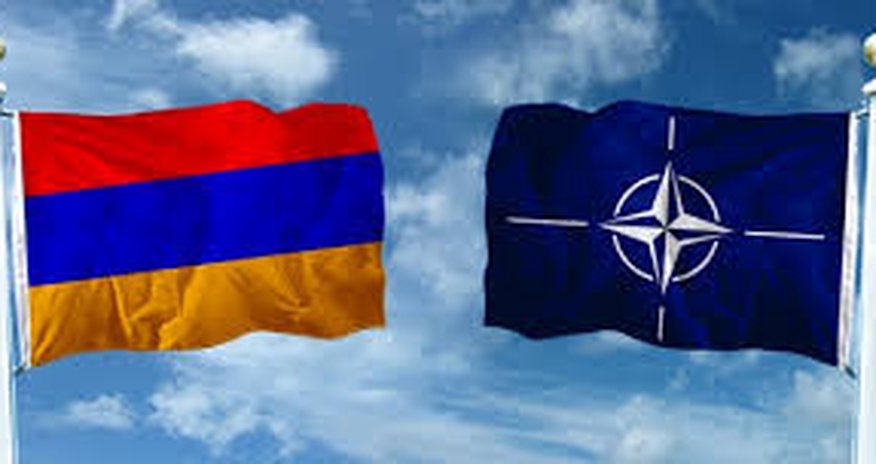
Russian expert says Armenia's relations with NATO are driven by pragmatism
28.03.2016 09:00


On 2 March 2016, Armenian Defence Minister Seyran Ohanyan held a meeting and negotiations with NATO Deputy Assistant Secretary General for Defence Policy and Planning Jonathan Parish. The Alliance's delegation arrived in Yerevan on the last day of winter. The declared purpose of this visit was to discuss the prospects of cooperation with Armenia.
According to NATO officials, they were satisfied with the outcome of the trip. A representative of the Political Affairs and Security Policy Division at NATO, Steffen Elgersma, said during the seminar, Armenia-NATO Relations: Prospects and Challenges ahead of the NATO Warsaw Summit, on 3 March that Brussels greatly values Armenia's participation in "international peacekeeping operations and its commitment to continuing cooperation in this field." It should be noted in this connection that Steffen Elgersma specifically touched on the subject of Armenia's membership in the Collective Security Treaty Organization (CSTO). According to him, it is "fully compatible with the objectives of the partnership" between the republic and the alliance and with the Individual Partnership Action Plan.
The NATO-Armenia topic is seen as relevant for several reasons. First, any moves by former USSR republics in the direction of the North Atlantic Alliance and the European Union raise serious concerns in the Russian political and expert community. Those concerns intensified after the Ukrainian crisis, which led to the worst confrontation between Russia and the West since the end of the "Cold War."
Second, Armenia occupies a special place on this list. Everybody is used to Georgia and Ukraine's North Atlantic aspirations. Regular statements by their official representatives on the desirability and usefulness of speedy accession to the "North Atlantic family" are received negatively but as old news, especially since the Western countries themselves do not yet promise Kiev or Tbilisi that the issue of their NATO status would be resolved soon. On 3 March 2016, the head of the European Commission, Jean-Claude Juncker, said that it would be at least another 20 years before Ukraine can join NATO or the EU. As for Armenia, it is the only South Caucasus republic which is a member of the CSTO and, since January 2015, it is also a member of the Eurasian Economic Union. The Russian Federation leadership see those two projects as the top integration priorities in the post-Soviet space.
Nevertheless, Yerevan attaches much more importance to bilateral cooperation with Moscow than to collective projects. The Armenian leadership has repeatedly subjected the CSTO to strong criticism for its vague position on the Nagornyy Karabakh conflict and, in particular, on incidents on the contact line and along the internationally recognized border between Armenia and Azerbaijan. For example, in October 2014, receiving CSTO general secretary Nikolay Bordyuzha in Yerevan, Armenian President Serzh Sargsyan said the following: "Our partners at the CSTO fail to react to Ilham Aliyev's militaristic and anti-Armenian statements appropriately, in a way that would restrain adventurist ambitions of the Azeri leaders." The Armenian leader said at the CSTO summit in Moscow held at the end of last year: "Of course, each country has its own interests and priorities, but this should not be opposed to the shared interests and mutual obligations of the organization's member states."
The Russian-Armenian military-political cooperation is another matter altogether. Back in 1995, the Russian Federation and the Republic of Armenia signed a treaty on the creation of a Russian military base on the Armenian territory, in Gyumri, on the border with Turkey, for a period of 25 years. In August 2010, Moscow and Yerevan signed a protocol prolonging the stationing of the Russian base on the territory of Armenia until 2044. Since then, according to the amendments [to the treaty], the base has been providing the security not only of Russia but that of Armenia too, together with the Armenian national army.
The relevance of the bilateral cooperation has only increased in light of the confrontation between Russia and Turkey over Syria (although before that Moscow and Ankara also had many differences in their approaches to various ethno-political issues in the Caucasus and in the Black Sea region). Official Yerevan was much clearer than Moscow's other Eurasian allies in its pronouncements on the actions of the Turkish military and Ankara's political position. Serzh Sargsyan said at the aforementioned CSTO summit, which was held in Moscow on 21 December: "This move by Turkey does not contribute anything to the consolidation of the international efforts aimed at combating terrorism, resolving the situation in Syria, and restoring peace in the region."
A well-known expert from the Yerevan-based Caucasus Institute, Sergey Minasyan, says correctly that Russia boosted its military presence in Armenia at the end of 2015 in line with the existing agreements, reached before the incident with the Russian bomber. Indeed, it was announced back in April 2015 that joint air defence systems would be created within the framework of the CIS in Eastern Europe, Central Asia, and the Caucasus. Russian President Vladimir Putin requested on 11 November that an agreement be drawn up with Armenia on the establishment of a joint regional air defence system in the Caucasus region. Nevertheless, the Russian-Turkish confrontation lent particular urgency to all these plans and, possibly, added a symbolic significance to it. On 23 December 2015, the Russian and the Armenian ministers of defence, Sergey Shoygu and Seyran Ohanyan, signed an agreement on a joint air defence system. It was also in December that the latest aviation equipment arrived [in Armenia]. Many [commentators] in certain information and political environments interpreted all these moves as the strengthening of the Moscow-Yerevan "axis." Naturally, the debate over the opposite "axis," that between Ankara and Baku, also intensified. Especially since tough confrontational statements by Turkish politicians and diplomats regarding the settlement of the Nagornyy Karabakh conflict were not long in coming.
However, not everything is black and white in the Caucasus geopolitics, as in any other geopolitics for that matter. There are much more tones and semitones there than sharp contrasts between NATO and Russia. Moreover, in cases when such a two-colour perception of reality becomes entrenched in the minds of the government and diplomatic elite, the situation is much more likely to develop according to a negative scenario. Speaking of Armenia and the North Atlantic Alliance, we should not forget that contacts between them did not begin yesterday or today but much earlier. On 28 January 2007, during the celebrations in Yerevan marking the 15th anniversary of the Armenian National Army, the then Armenian Minister of Defence (and now President) Serzh Sargsyan publicly noted the "great importance" of his country's cooperation with NATO: "This cooperation helped modernize the army and implement international practices, and this process now continues." Armenian military contingents (albeit few) have participated in international operations in Kosovo, Iraq, and Afghanistan, for which were repeatedly praised by NATO representatives.
However, there are weighty factors limiting the extent of Yerevan's integration with North Atlantic Alliance. First of all, this is the Turkish factor (Turkey has the second largest army in NATO after the United States). Ankara has consistently supported Azerbaijan's position in the Nagornyy Karabakh conflict (although Baku's position on the Russian-Turkish confrontation or the conflict in Syria cannot be described as identical to the approaches of President Recep Tayyip Erdogan) and infrastructure projects that increase Armenia's isolation from the outside world. The most important factor, however, is the bilateral Armenian-Turkish relations, which have their own dynamics, even outside the Karabakh context. But the context does not help either. This has given rise to the concerns that the "price" Armenia may have to pay to be allowed to [move towards] the West may be its renouncing, in one form or another, of Nagornyy Karabakh, which has become the cornerstone of Armenia's post-Soviet identity. Especially since the Alliance is not planning to review its strategic relationship with Turkey and the EU is not prepared to stop its energy partnership with the Caspian republic, despite criticism against Baku of human rights violations.
It seems unlikely in the current environment that this approach will undergo a radical revision. However, it must be noted that attempts are being made in expert and media circles as well as on social networks to highlight topics such as the cost of being a "fortress state" and the cost of the alliance with Russia. It would be wrong to ignore them or to consider them as purely marginal topics. Unless, of course, you limit the prospects of Russian-Armenian cooperation to the horizon of the next election campaign.
However, the existence of factors limiting progress towards NATO does not mean the lack of interest in Yerevan in pursuing a diversified policy. In September 2013, the Armenian leadership chose for Eurasian integration, and the topic of foreign policy complementarity has somewhat faded. But it has not disappeared, it is just off the radar. It is critically important for Armenia not to let Azerbaijan, which has its own reasons for a partnership with the Alliance, monopolize the Karabakh issue. By the way, the prospects of cooperation between the Caspian republic and NATO will also be discussed in the run-up to the Warsaw Summit. A statement by the Romanian embassy in Baku, released on 3 March, says: "Romania, in the capacity of coordinator of NATO's activities in Azerbaijan, supports and strengthens cooperation between the Alliance and Azerbaijan. Azerbaijan is a very important and valuable partner of NATO." At the same time, Armenia is interested in maintaining constructive relations with the [Armenian] diaspora in the West. The total number of Armenians living in the United States and France (the two countries co-chairing the OSCE Minsk Group) equals 1.5m people. And these are not just ethnic Armenians dispersed all over the world, these are also serious political, media, and economic lobbyists for the interests of the independent Armenia, whose influence should be neither overestimated nor ignored.
Thus, through its practical actions, Armenia proves, once again, an extremely important point. The foreign policy aspirations of a small country are not only and not so much a choice between different centres of power (which multiplies risks) as the attempt to find a modus vivendi in a relationship with them. There are many factors limiting Yerevan's movement towards NATO, while an alliance with Russia is seen as advantageous here and now. But Armenian diplomats cannot ignore the world's largest political-military bloc or the position of its individual members. In this case pragmatism comes to the fore. It comes before romantic illusions or unrealistic expectations.
www.ann.az


Facebook
Follow us on Facebook


Similar news
Similar news

World 12:30
Iran Urges Middle East Nations to Reject US Military Support, Warns of Retaliatory Strikes











 Photo




 Video


