





Born free, killed by hate - the price of being gay in South Africa
07.04.2016 12:33


South Africa's constitution was the first in the world to protect people from discrimination because of their sexual orientation.
The country was also the first in Africa to legalise same-sex marriage. But after a spate of murders, gay people say more needs to be done to stop hate crimes.
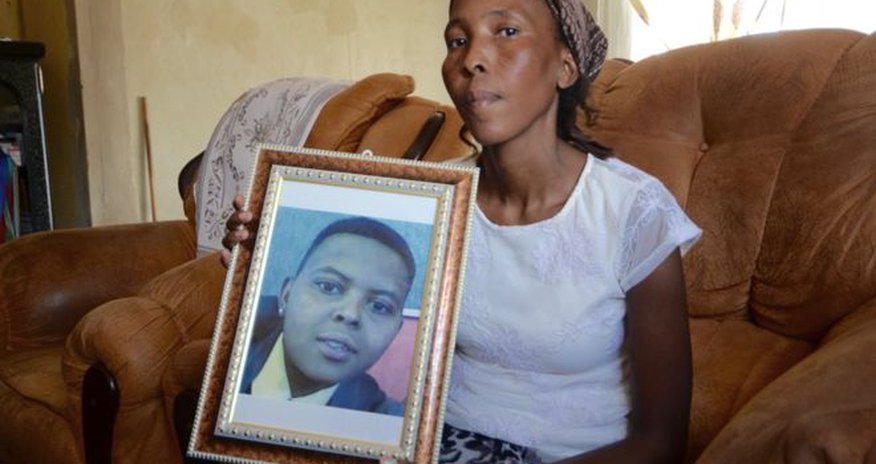
Betty Melamu sits on a brown leather sofa in her living room in the township of Evaton, just south of Johannesburg. She's cradling a framed picture of her daughter Motshidisi Pascalina, known as Pasca.
In a quiet, wavering voice, she sings Pasca's favourite song.
"Whenever she would listen to radio or go to church she would sing that song," she remembers.
When I ask if Pasca was a good singer she says, "Yes," and laughs - apparently Pasca was more spirited than talented, constantly switching between parts as she sang.
She loved football too, studied hard at school and wanted to be a politician.
"She wanted to do something good," says Melamu with pride.
But the laughter and happy memories are fleeting, and sadness is etched in her thin, drawn face. Pasca was a lesbian, something her family knew and accepted. She had just turned 21 and completed her final high school exams when she went to a party in December.
"I don't know what happened after the party," says Melamu. "But she didn't come back."
Two days later Pasca's body was found in a field in a neighbouring township. She had been beaten and mutilated. At the morgue her family couldn't recognise her face and could only identify her by a tattoo on her leg.
"At that time I was strong," Melamu remembers. "But after that I feel like I am crazy woman."
And as we talk, she repeats one question, over and over.
"Why? Why did this happen to my child?"
Pasca was was born in 1994, the year apartheid ended and Nelson Mandela was elected president - she was one of the first of South Africa's so-called born free generation.
In his inauguration speech, Mandela promised to "build a society in which all South Africans will be able to walk tall, without any fear in their hearts... a rainbow nation at peace with itself and the world."
But 21 years later, this promise remains unfulfilled for the country's lesbian, gay, bisexual, transgender and intersex (LGBTI) community.
In a country where crime rates in general are high, black lesbians in poor townships face particular risks and often suffer the most violent crimes.
As women, they're vulnerable in a country with one of the highest rates of rape in the world. As lesbians in an often homophobic and patriarchal society, they face a further danger - the idea that they can be "changed" and "made into women" through what is known as "corrective rape".
It's suspected this may have happened to Pasca, although the post-mortem was unable to determine this.
And when crimes happen, there's no guarantee that the response will be adequate. Victims say they often face secondary harassment by police or health care workers.
Pasca's case was assigned to a police officer who was on leave at the time, only returning to work two and a half weeks later.
Frustrated at the delay in this and two other rape cases, in January activists took to the streets of Evaton with rainbow flags and banners. Chanting "Pasca is our sister," they marched to the local police station to demand justice.
"The police are not doing anything," Lindiwe Nhlapo told me several weeks later. She's part of Vaal LGBTI, one of the groups that organised the march. "The police are failing us big time."
Since then, the police have tried to address concerns about the investigation into Pasca's death, but frustration with the justice system is a common story.
In the nearby township of KwaThema, silver drapes and rainbow flags adorn the living room of the small house that's the headquarters of the Ekurhuleni Pride Organising Committee (EPOC).
There's also bar down one end and a sign on the wall - Divas and Dykes Lounge. Day or night, this is a safe place for gay and transgender people to socialise.
"I can't walk with my partner on the street and hold their hand," says Bontle Kahlo, from EPOC. "I can't go out at night and say 'I'm going to dance somewhere,' because I'm not safe. I might get killed because of who I am, because of who I love."
She points to a frame on the wall containing photos of dozens of LGBTI men and women.
"This is our memory wall," she says. Some of them died of natural causes, but many of the lesbians in the pictures were murdered because of their sexual orientation.
"Women are less than men," says Kahlo. "If you're a black woman, you are even less, and if you're a black lesbian woman you are basically nothing in this country."
Among the faces on the wall is Noxolo Nogwaza, a 24-year-old lesbian who was raped, mutilated and murdered in 2011.
But five years later, no-one has been prosecuted.
"The feeling we got from the police is that they expected us to do all the work for them," says Kahlo.
"It's very tiring to be an activist but to also be a police officer and to try as hard as you can, and to have a government which is not supportive."
Her partner and fellow campaigner Ntuspe Mohapi nods in agreement.
"They're good at talking but not at acting," she says.
When they heard about Pasca's murder, there was a familiar sadness.
"I think it's getting worse," Mohapi says. "And these are just the cases of murder that we are talking about. We haven't started with rape, or hate speech, and the bullying in schools, and the suicides of gay teenagers."
South African law doesn't classify hate crimes differently from other crimes, so there are no official statistics to turn to.
The organisation Iranti-org is funded by the EU to document violence against LGBTI people - it has counted more than 30 murders and rapes in the country since 2012.
Pasca was just one of three LGBTI people killed in South Africa during a six week period late last year. The deaths barely received a mention in the mainstream media.
There hasn't always been a lack of interest though. After the murder of Noxolo Nogwaza and several other lesbians in 2011, there was a global outcry. 170,000 people signed a petition calling on the government to act.
In response, the government set up a National Task Team and drew up a National Intervention Strategy to reduce hate crimes.
It also established a Rapid Response Team to make sure that hate crimes are properly investigated and the perpetrators prosecuted. This has had some success in clearing a backlog of murders and other crimes.
But the government is not doing enough says Mpaseka "Steve" Letsike, co-chairwoman of the National Task Team and head of LGBTI organisation Access Chapter 2.
"We are not getting it right. There's a huge gap. We need to invest our energies into prevention, into conversations, into dialogues."
The government is doing some of this - funding awareness campaigns and training police and health workers. But "it's still a drop in the ocean," says Letsike.
(BBC)
www.ann.az


Telegram
Follow us on Telegram


Similar news
Similar news

World 12:30
Iran Urges Middle East Nations to Reject US Military Support, Warns of Retaliatory Strikes











 Photo




 Video


