





North Korea: Searching for self-reliance and 'real people' in Pyongyang
03.05.2016 14:31


A team from the BBC is making a rare visit to North Korea organised by the Vienna-based International Peace Foundation (IPF). The team is joining a delegation of three Nobel laureates and a European prince. The BBC's Rupert Wingfield-Hayes reports from Pyongyang.
Our three Nobel Laureates are on their minibus, we are on ours, surrounded by four or five minders - it's hard to keep count. We are heading for the Monument to the Juche Idea, an enormous phallic stone construction rising 170m from the south bank of the Taedong river in the centre of Pyongyang.
Juche is the central guiding ideology of this country, except it's not really an ideology.
It roughly translates as "self-reliance" - the idea that the Democratic People's Republic of Korea doesn't need help from other countries, that it can develop in to a modern nation by itself.
Except, of course, it can't.
'Great Marshall'
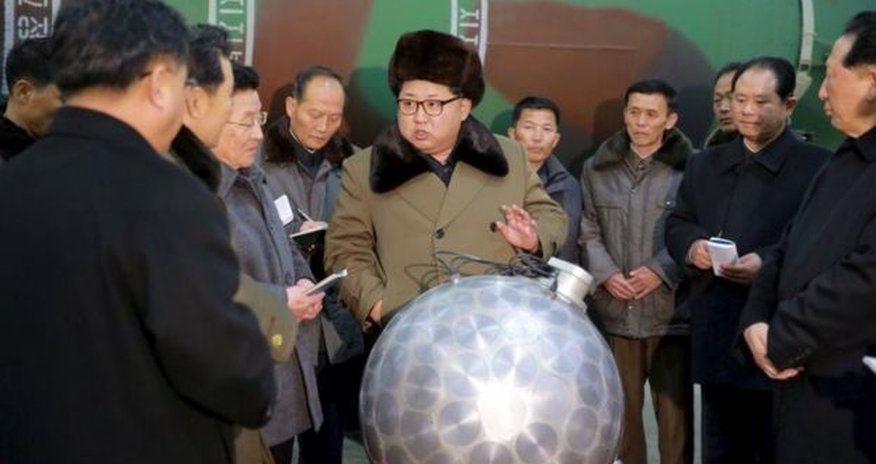
North Korea may have built a nuclear bomb and long-range rockets, but not without help. Almost everything modern you see comes from China. The mobile phones, computers, cars. The regime can barely feed its own people.
But there is money here, more than there was 12 years ago.
From atop the tower we look across the river to Kim Il-sung square. It is filled with colourfully clad crowds practising mass dancing.
"What are they celebrating?" I ask Mr Kim.All of our minders seem to be called Mr Kim.
"They are practising for the Party Congress," he answers.
Next Friday, in a huge grey marble edifice in the centre of Pyongyang, the 7th Congress of the Korean Workers Party will open. The 6th congress was held more than 35 years ago, so this is going to be a big deal.
Our minders already refer to Kim Jong-un, the 30-something dictator, as "The Great Leader Marshal Kim Jong-un".
What exactly he's done to deserve the title Marshal is hard to say. On state TV the increasingly obese young ruler seems to spend a lot of time sitting in a large chair watching artillery firing at mountainsides.
Building bridges
The academics' visit to North Korea has been organised by the Vienna-based International Peace Foundation (IPF).
Those taking part are from second second left to right:
Nobel laureate for economics Prof Finn Kydland from Norway, who works at the University of California in Santa Barbara.
Prince Alfred of Liechtenstein, who chairs the IPF's advisory board.
IPF chairman Uwe Morawetz, who has visited North Korea six times in the past two years.
Nobel laureate for medicine Sir Richard Roberts from the UK, who is based at New England Biolabs in Ipswich, Massachusetts.
Nobel laureate for chemistry Prof Aaron Ciechanover from the Technion Israel Institute of Technology in Haifa.
(BBC)
www.ann.az


Facebook
Follow us on Facebook


Similar news
Similar news
World 12:30
Iran Urges Middle East Nations to Reject US Military Support, Warns of Retaliatory Strikes



 Photo




 Video


