





The volcanoes no one has ever seen
10.08.2016 18:01


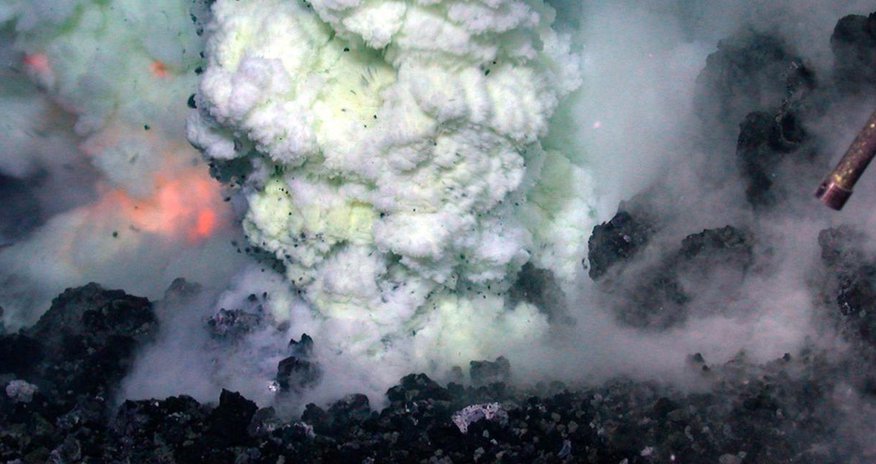
Deep-sea volcanoes are so remote, until recently we did not even know they existed. Now we can see them like never before
We do not see them erupt, yet more than half of the Earth's crust can be attributed to their dramatic explosions.
It sounds almost like a riddle. But when you understand the facts, the truth might be even more surprising.
The remnants of hundreds of thousands of deep-sea eruptions lie on the ocean floor, deep below the surface of the water.
"Beyond a basic understanding we know very little about these volcanic processes," says Isobel Yeo of GEOMAR's Helmholtz Institute for Ocean Research Kiel.
Despite our ignorance, almost 70% of the Earth's crust is believed to be produced at mid-ocean ridges such as the Mid-Atlantic Ridge (see below). These are the places where tectonic plates move away from each other.
As they do so, magma can erupt into the space, forming new crust where the plates once were. These processes are so powerful that they form enormous volcanoes, similar to Iceland's 2014-2015 Bardarbunga volcano eruption.
In fact, the mid-ocean ridges form the largest volcanic systems on Earth. But as they are largely hidden from sight, they have long remained elusive. That is something Yeo hopes to change.
"We have very little idea about the frequency and style of volcanic eruptions on the seafloor, nor the detailed structure of the crust they produce, so basically we don't really know what the crust of a large part of the Earth looks like."
That is why Yeo and colleagues have been collecting detailed images of the sea floor, 700-2,000m (2,297-6,562ft) down.
To reconstruct sub-surface volcanic history, she developed a new method to date lava flows using "hydroacoustic properties". This involves analysing how much sound the lave flows reflect back when they are hit with sonar.
Her findings, published in April 2016, revealed that these enormous eruptions occurred in the last 4,000 years. In geological terms this makes them baby volcanoes.
Yeo and colleagues returned to this site at the North Kolbeinsey Ridge, about 311 miles (500km) off the north coast of Iceland, in July 2016.
Using a torpedo-like underwater autonomous robot, they were able to capture thousands of high-resolution photos of the seafloor, never seen in such detail before. The pictures, featured here, are of such high quality that the seafloor can now be surveyed in much the same way geologists do on land.
"These observations, combined with the spatial extents of the flows, mean we can work out how much lava erupted where and when," Yeo says.
(BBC)
www.ann.az


Telegram
Follow us on Telegram


Similar news
Similar news
World 12:30
Iran Urges Middle East Nations to Reject US Military Support, Warns of Retaliatory Strikes









 Photo




 Video


