





Scientists find Earth-like planet circling sun's nearest neighbor
25.08.2016 23:01


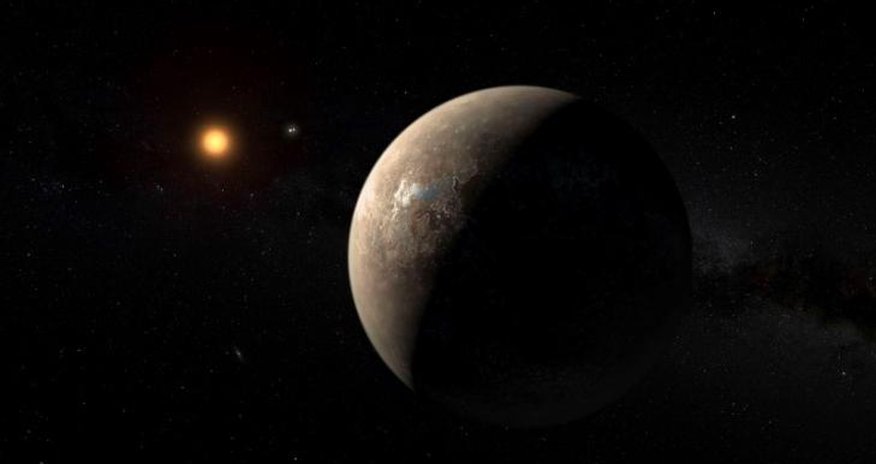
Scientists have discovered a planet that appears to be similar to Earth circling the star closest to the sun, potentially a major step in the quest to find out if life exists elsewhere in the universe, research published on Wednesday showed.
The relative proximity of the planet, known as Proxima b, gives scientists a better chance to eventually capture an image of it, to help them establish whether it has an atmosphere and water, which is believed to be necessary for life.
Future studies may reveal if any atmosphere contains tell-tale chemicals of biological life, such as methane, according to a paper published in this week's issue of the journal Nature.
"The key question of our initiative was whether there were potentially life-bearing planets orbiting these stars. We know now there is at least one planet with some characteristics similar to the Earth," said Pete Worden, a former top NASA manager, who was speaking at a European Southern Observatory webcast news conference to announce the find.
The planet, located about 4.2 light-years from Earth, or 25 trillion miles (40 trillion km), is the closest of some 3,500 planets that have been discovered beyond the solar system since 1995, according to the paper.
"This planetary system is much closer than any other that we know so detailed investigation is easier," astronomer Ansgar Reiners, with the University of Gottingen in Germany, told reporters on a conference call.
Astronomers got their first hint of a planet circling the sun's small dim neighbor star in 2013. But they needed additional observations, using more precise instruments, to make a definitive call.
An international team of 31 scientists found the planet after careful and repeated measurements of slight shifts in the color of the light coming from its host star, Proxima Centauri, which is a small, dim star in the Alpha Centauri system.
The shifts, which astronomers call "wobbles," are caused by the gravitational tugging of a planet roughly 1.3 times the size of Earth on the parent star. Based on the timing of wobbles, scientists determined that the planet circles its host star in just 11 days, compared to Earth's 365-day orbit around the sun.
That puts the planet far closer to its parent star than Earth orbits the sun. However, Proxima Centauri is so much smaller and dimmer than the sun that its planet's orbit is suitably positioned for liquid water despite being just 4.4 million miles away.
EARTH-LIKE PLANET
"Chances are good that it's a viable, Earth-like planet today," said astronomer Pedro Amado, with the Instituto de Astrofísica de Andalucía in Granada, Spain.
But scientists are unsure if red dwarf stars like Proxima Centauri are good hosts for life. Planets orbiting close enough to keep water liquid would be blasted with 100 times more high-energy radiation than Earth receives from the sun, though what impact that would have on life is a matter of scientific debate.
"We don't think it's a show-stopper," Amado said.
Magnetic fields and an atmosphere offer a planet some protection. It is unknown if Proxima b has either.
Before the discovery of Proxima b, the nearest Earth-like planet to the sun was circling a star known as Wolf 1061, located about 14 light-years away.
Proxima b may not be flying solo. "We have some suspicions that there is another signal around the star," Reiners said.
More research is needed to determine if there are multiple planets circling Proxima Centauri.
The discovery announced on Wednesday is expected to bolster a $100 million project unveiled in April and backed by Russian billionaire Yuri Milner to develop a miniature laser-powered spacecraft that can make the trip to the Alpha Centauri system in about 20 years.
"We hope to build a whole system that will send nanocraft to Proxima Centauri and Alpha Centauri within a generation," said Worden, the executive director of Breakthrough Starshot, an initiative that aims to deploy thousands of tiny spacecraft to travel to our nearest neighboring star system and send back pictures.
(reuters.com)
www.ann.az


Youtube
Follow us on Youtube


Similar news
Similar news

World 12:30
Iran Urges Middle East Nations to Reject US Military Support, Warns of Retaliatory Strikes











 Photo




 Video


