





Syria conflict: Life under siege in rebel-held Aleppo
06.10.2016 20:01


Aleppo was once a place of culture and commerce, with a jewel of an old city that was on Unesco's list of world heritage sites.
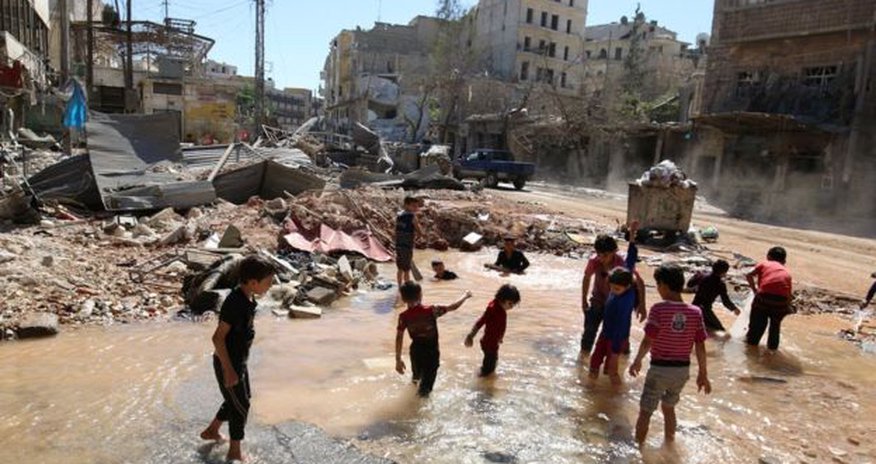
Now, the five-year civil war that rages in Syria has left much of it destroyed and divided roughly in two, with President Bashar al-Assad's forces controlling the west and the rebels the east.
A month ago, government forces re-imposed a siege on the east, and launched an all-out assault to take full control of the city, accompanied by an intense and sustained aerial bombardment.
Activists say the offensive has left hundreds of civilians dead, but the government and its ally Russia have denied targeting them and blamed rebel fighters for operating in residential areas.
But what about the more than 250,000 people who are trapped there? Where are they getting their food from? Do they have enough water and medicine?
The quality of daily life depends on where you live
There is no single group in charge in eastern Aleppo - it is divided between mainstream rebels backed by the US and its allies, the jihadist group Jabhat Fateh al-Sham, and Kurdish forces who say they support neither the government or the opposition.
In the Kurdish-controlled district of Sheikh Maqsoud, markets are well stocked and prices are stable, according to the Reach Initiative, which is in touch with people on the ground to gather regular humanitarian reports.
One road out of Sheikh Maqsoud has opened up in the daytime, allowing people to get out and goods to get in. But the district is surrounded by checkpoints, meaning people from the other areas under siege cannot get in and out easily.
In other parts of eastern Aleppo, the situation is more urgent. Generators are running out of fuel, meaning electric power is sporadic, and some air raid shelters - where residents may spend hours or wait overnight for bombing to stop - are not wired with electric light at all.
Food and water have become weapons of war
Humanitarian aid agencies have been unable to get into eastern Aleppo since the siege resumed on 4 September.
Both the United Nations and the International Committee of the Red Cross have been calling for humanitarian corridors to be opened up since then, but so far those calls have been ignored.
That said, charities are still in contact with people who live there.
Reach says some markets are still up and running in parts of Aleppo under siege, but for key foodstuffs like eggs, flour, vegetables, fruit, chicken and cooking oil, whether you will get them or not is touch-and-go.
In three districts - Qadi Askar, Masakin Hanano and Tariq al-Bab - markets have run out of flour completely. Reach says some people are rationing their last pieces of dried bread and tubes of tomato paste, while others are bartering what is left in their cupboards.
For food that you can get, the price is hugely inflated.
Before the conflict, seven pieces of flatbread cost 15 Syrian pounds. Now, it comes in packets of six pieces, costing 451 Syrian pounds on average (£1.66, $2.12) - expensive in a city under siege, where many ways of earning money have disappeared.
Water, too, has become a weapon in the war as government forces attempt to make the rebels and civilians in eastern Aleppo surrender.
Pumping stations have been damaged in the bombing and most of the city - including parts of the government-held west where some 1.2 million people live - has no running water coming out of the taps.
People are buying water from wells and privately-owned water tankers, and carrying it home in buckets. Many have reported that it tastes bad, and there is no guarantee that it is free of disease.
It is hard to say whether anyone has died of hunger in the siege because with aid agencies unable to get inside, they cannot accurately diagnose the level of malnutrition.
But Pablo Marco from the charity Medecins Sans Frontieres (MSF) said: "The siege is pushing people towards starvation."
There are hardly any doctors left
Many doctors have fled the city as refugees or been killed in the fighting, and there are just 35 doctors remaining in eastern Aleppo, according to charities.
Using the conservative end of estimates for the number of people trapped there - 250,000 - that means there is roughly one doctor for every 7,000 people.
This in a place that is being bombed every day.
The places where doctors work have been repeatedly targeted by government and Russian air strikes, activists and charities say. The World Health Organization says just five hospitals are still operating, although they are only partially functional.
Mr Marco from MSF painted a troubling picture of the state of healthcare in the area.
He said: "The few remaining hospitals are collapsing under a flow of hundreds of wounded lying in agony on the floors of wards and corridors.
"Doctors are performing brain and abdominal surgeries to the victims of bombing on the floors of the emergency rooms, for lack of available operating theatres."
But some creative innovation helps save lives. Some doctors are using Skype to get help carrying out operations that they personally have never done before.
Other medical facts of life in besieged Aleppo:
Because of the siege and the violence, there are no more emergency medical evacuations out of rebel-held districts
Some ambulances have been destroyed in attacks and a shortage of fuel means there are fewer private cars on the road, making it harder to get patients to a place where they can be treated
Doctors are short of blood for blood transfusions
Doctors also say they have been forced to recycle syringes, needles and bandages, operate on patients without anaesthetic and use salted water instead of medical saline to sterilise wounds.
And it is not just in the aftermath of air strikes that people's health and lives are at risk. Medications for heart disease, diabetes and other long-term conditions are running short too.
Zulfiye Kadim of Reach Initiative said long-term medical supplies are frequently reported as being the most urgent. She said: "They're not something that can be left out in favour of conflict-related medications. They are actually prioritised."
Women's hygiene products like sanitary pads are not easily available in besieged Aleppo, except in the Kurdish-controlled area. Women and girls who are on their periods are forced to use old rags instead of disposable sanitary pads.
As water is not guaranteed to be clean, doing so means they could get infections.
(BBC)
www.ann.az


Twitter
Follow us on Twitter

Similar news
Similar news

World 12:30
Iran Urges Middle East Nations to Reject US Military Support, Warns of Retaliatory Strikes











 Photo




 Video


