





Female Arab cartoonists challenge authority
28.11.2016 16:00


In some Arab countries women still have to ask permission from a male relative to get a passport, marry or leave the country.
Although the practice of "male guardianship" is not always enshrined in law, it persists in everyday life within many families.
As part of the 100 Women season, the BBC asked three female cartoonists from North Africa to take up their pens and illustrate how the custom continues to affect women's lives in their countries.
Egypt
"The issue that symbolises male guardianship most in our country is the question of young brides," says award-winning Egyptian cartoonist Doaa el-Adl.
"There is a trend for wealthy Gulf men to travel to the impoverished Egyptian rural areas to find much younger, temporary brides."
As a hard-hitting political cartoonist tackling taboo issues like FGM and sexual harassment, el-Adl frequently courts controversy and has even been accused of blasphemy.
The phrase 'young brides' means girls who have just reached the legal age for marriage in Egypt - which is 18 - but whose families marry them off to much older foreign men.
In many cases, the men see these marriages as short-term arrangements and abandon the girls soon afterwards.
El-Adl points out that, paradoxically, a law introduced to try to stop the practice has actually encouraged it.
If a foreign man wants to marry a girl who is more than 25 years younger than him, then he is obliged to pay her family the equivalent of just over US$6,000 (£4,800).
While that is a relatively small price to pay for a wealthy man from the Gulf States, it has proved a big incentive for poor Egyptian families, struggling to cope in increasingly desperate economic times.
"The men in these societies are basically selling these girls off," says el-Adl. "And the state has failed to stop this happening."
Tunisia
"When I first started drawing, I did so anonymously and everyone assumed I was a man," says Tunisian cartoonist Nadia Khiari.
"They couldn't imagine that a woman could even draw, let alone sketch characters full of humour and wit."
Khiari is the creator of Willis from Tunis - a cartoon cat whose adventures provide a wry commentary on life in post-revolutionary Tunisia.
Her chosen theme for this cartoon - which also features Willis - is the continuing pressure on rape victims to marry their attackers in order to avoid bringing shame on their families.
She was inspired to draw the cartoon in response to controversial comments by a male Tunisian TV talk show host who was suspended from his job in October, after suggesting that a young girl who had been subject to years of sexual abuse by three male relatives should marry one of them when she became pregnant.
Attitudes like this persist, Khiari says, despite new legislation introduced in 2014 to enshrine gender equality in the country's new post-Arab Spring constitution.
"The body of a woman belongs to her family and even if she has been subjected to sexual violence, it is the honour of the family that must be preserved above everything, she says.
"The Tunisian administration doesn't recognise rape for what it is. It isn't seen as a serious crime."
Morocco
Riham Elhour was the first ever female cartoonist to be published in the Moroccan press.
Her birthday is on International Women's Day, 8 March, and she says she was "born a feminist."
What started as a childhood hobby became her profession when she won a Unesco award more than 15 years ago.
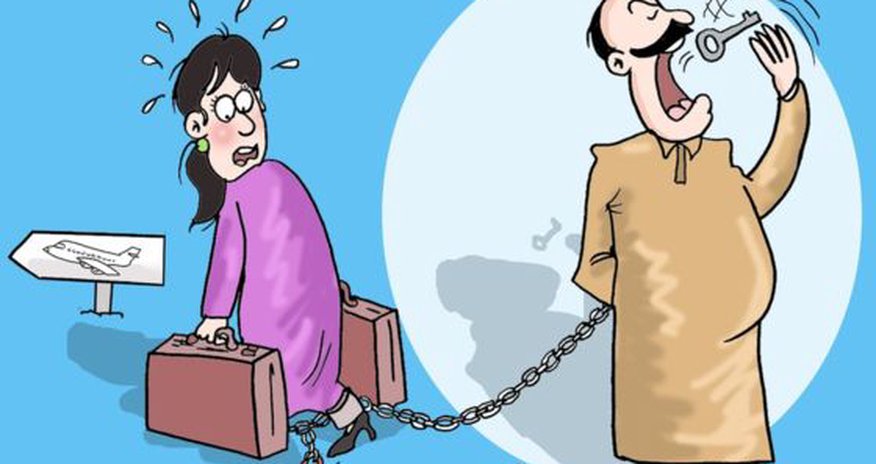
The theme she has chosen for her cartoon is foreign travel, and the numbers of Moroccan men who are using the law to stop their wives travelling abroad.
Although many of Morocco's male guardianship laws were overturned in reforms in 2004 and 2014, women still legally need their husband's formal permission to leave the country if they want to take their children with them.
"Men can use this to control women's lives," Elhour says.
Riham Elhour is still the only female cartoonist at her newspaper.
But she remains firmly convinced that through her art she will be able to change the way women are seen in Morocco.
"I want my drawings to stir women to fight for their rights," she says. "I don't want them to moan about being the victim. I am a fighter. All women are fighters."
(BBC)
www.ann.az


Facebook
Follow us on Facebook


Similar news
Similar news

World 12:30
Iran Urges Middle East Nations to Reject US Military Support, Warns of Retaliatory Strikes











 Photo




 Video


