





This is the first photograph taken on a comet in history
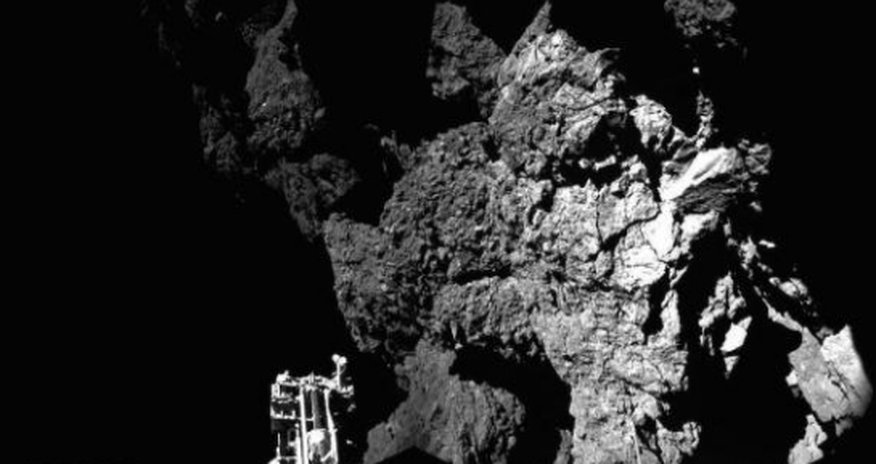


Humanity has landed on a comet - and now we have the picture to prove it.
This is the first photograph taken on a comet in history.
But there is bad news too: the European Space Agency said that its Philae lander, launched from the Rosetta mothership on Wednesday, is not attached to the comet's surface. None of the systems designed to lock it in place - harpoons, ice screws or thrusters - worked.
As such the long-term viability of the lander is in doubt.
ESA said the lander is sloping - maybe on its side - but that they have 7 images and a panorama which will be published at a 1pm press conference.
The lander was described as "stable" by Rosetta project scientist Dr Matt Taylor, who said the European Space Agency was receiving a good signal and receiving science data.
He said: "Now we are busy analysing what it all means and really trying to find out where the lander actually is on the surface."
Philae touched down yesterday after a 10-year, four billion-mile journey through space in an achievement hailed as one of the greatest in science.
Scientists hope the probe will yield insights into the origins of our Solar System.
Philae landed in a soft area on the 67P/Churyumov-Gerasimenko comet and dipped around 1.6in (4cm) before bouncing back up when its harpoon failed to fire.
It went straight back up for two hours and drifted out into space before descending to the surface, bouncing again for a few minutes before settling in what Dr Taylor described as "three landings for the price of one".
Dr Taylor added: "We know it's stable and sitting in place - that's about as stable as we could wish for at the moment - and the next few hours should give us a bit more illumination on what the situation is there."
Discussions are taking place on whether the probe's two harpoons should be fired now to make sure the craft is fastened down in the comet's ultra-low gravity.
ESA experts are also looking into the implications of deploying a drill which can bore out samples to a depth of 9in (23cm).
It is hoped that in the next few hours new pictures from the surface of the comet may become available.
The probe is equipped with several cameras and a suite of 10 instruments.
One British-led instrument, Ptolemy, is expected to be used to analyse the composition of samples in the craft's on-board laboratory.












 Photo




 Video


