





Was Russia's South Stream too big a 'burden' to bear?
03.12.2014 13:30


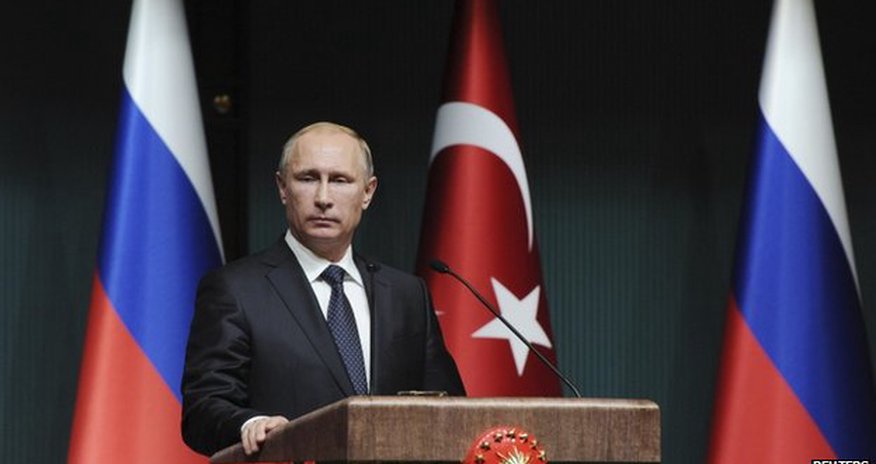
Russian President Vladimir Putin's announcement that he is cancelling the planned $50bn (£32bn; €40bn) South Stream gas pipeline has caused a mixture of surprise, relief and dismay in countries dependent on Russian gas across central and eastern Europe.
Russia's critics have long argued that, parallel to nuclear expansion, gas pipelines constitute "the long fingers of the Kremlin", opening the way for political as well as economic influence. So this decision is a dramatic change of direction.
"It may be a bluff," said Martin Vladimirov, an energy specialist at the Centre for the Study of Democracy in Sofia, "to pressurise the Bulgarian, Serbian, Hungarian and Austrian governments to unite behind accelerating the project, and make a better case for it to the European Commission".
However, he favours a second explanation, that South Stream is "simply too big a burden" amid the difficult financial situation facing Russia's state-owned giant Gazprom.
Europe has a falling demand for gas, and does not need the potential 63bn cubic metres (cu m) a year that South Stream would provide. The North Stream pipeline is only filled to a fraction of its similar capacity, and runs at a loss.
Instead, Mr Vladimirov believes, Gazprom is looking to new markets, turning its gas strategy eastwards. "It would need $100bn in the next four to five years to develop the Eastern Siberian fields and construct a pipeline to China," he says.
Scrapping South Stream comes as a setback to the governments in Hungary and Serbia, among the strongest backers of the project, alongside the Austrian company OMV and the Italian ENI.
Much of the gas would have reached the massive Central European Gas Hub at Baumgarten in Austria, which is partly Russian owned. Around a third of Russia's gas exports to Western Europe pass through Baumgarten.
But when Bulgaria suspended work at Varna on the Black Sea coast where the pipeline came ashore, the project became untenable.
Hungarian Foreign Minister Peter Szijjarto said that his country would have to find alternative gas supplies, as a result of the Russian decision.
But in Ukraine the response to President Putin's announcement was one of relief.
"The cancellation of South Stream was made for economic reasons, disguised behind a political explanation," said Andrii Tiurin of Ukrainian nuclear company Energoatom.
"Why spend so much money creating alternative routes to supply the same gas? At a time of low and falling oil prices, why spend so much on a project which is unnecessary for Europe?"
Ukrainians also point to the extra financial cost to Russia of annexing Crimea, as well as the impact of EU and US sanctions because of Russian support for separatists in eastern Ukraine.
At the end of October, Ukraine finally signed a new gas deal with Russia, valid until March, to guarantee gas supplies this winter. Ukraine's demand for Russian gas has fallen as it has sought supplies elsewhere.
New pipelines
Champions of a more diversified gas supply, weaning Europe off its dependence on Russian gas, hope that the scrapping of South Stream will speed progress towards a common European Union energy policy.
Most pipelines were constructed in Soviet times from East to West. Energy experts in eastern and central Europe have long argued for better North-South connections.
A new pipeline connecting Hungary and Slovakia is due to open in January, and work continues on a similar project between Hungary and Romania.
The construction of liquefied natural gas (LNG) terminals at Swinoujscie in Poland, Klaipeda in Lithuania and Omisalj in Croatia will also add to the diversity of supply, with liquefied gas set to arrive from Qatar and North Africa, and possibly the US in the future.
From 2019, gas from Azerbaijan is due to enter Europe through the Trans Adriatic pipeline (TAP).
While Europe will remain dependent on Russian gas for a long time, however cool political relations become, a diversity of supply allows countries to negotiate lower prices with Gazprom.
Pinning the blame for the demise of South Stream on Brussels in general and Bulgaria in particular, President Putin's message was blunt.
"The EU will not benefit from Russian gas any more. That is their choice."'
(BBC)
ANN.Az


Instagram
Follow us on Instagram
Similar news
Similar news

World 12:30
Iran Urges Middle East Nations to Reject US Military Support, Warns of Retaliatory Strikes











 Photo




 Video


