





How Russia outfoxes its enemies
29.01.2015 22:30


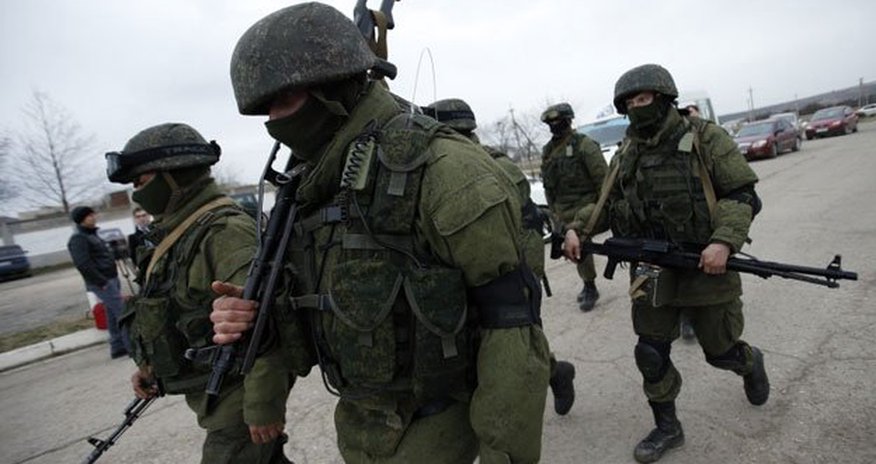
Russia's annexation of Crimea last year caught almost everyone off guard. The Russian military disguised its actions, and denied them - but those "little green men" who popped up in the Black Sea peninsula were a textbook case of the Russian practice of military deception - or maskirovka.
At a cadet school in the southern suburbs of Moscow, Maj Gen Alexander Vladimirov heaves two enormous red volumes off his bookcase and slams them down on the table. "My Theory and Science of Warfare," he says, beaming. "It's three times longer than Leo Tolstoy's War and Peace!"
Vladimirov, vice-president of Russia's Collegium of Military Experts, is an authority on maskirovka - the hallmark of Russian warfare and a word which translates as "something masked" or "a little masquerade".
"As soon as man was born, he began to fight," he says. "When he began hunting, he had to paint himself different colours to avoid being eaten by a tiger. From that point on maskirovka was a part of his life. All human history can be portrayed as the history of deception."
Vladimirov quotes liberally from the Roman general Frontinus and the ancient Chinese philosopher Sun Tzu who described war as an eternal path of cunning.
But it's Russia, he tells me, with unmistakable pride, that has over the centuries really honed these techniques to perfection.
One of the most famous examples is the Battle of Kulikovo Field in 1380, when the young Muscovite, Prince Dmitry Donskoy, and 50,000 Russian warriors fought against 150,000 Tatar-Mongolian soldiers led by Khan Mamai. It was the first time the Slavs were fighting as a united army - Russia against the Golden Horde.
"The fighting was very tough, but we eventually triumphed thanks to one regiment hiding in the forest," says Vladimirov. "They attacked ferociously and unexpectedly and the ambushed Tatars ran away."
But that was just a start. Vladimirov reels off some more recent legendary battles in which Russia outfoxed its enemies, with flare and cunning.
There was the Jassy-Kishinev operation of August 1944, which featured dozens of dummy tanks as well as whole Red Army divisions sent in false directions to throw the Germans off the scent.
And that came just after Operation Bagration in Belorussia had dealt Hitler's troops a devastating blow.
"It was clear the military skill of Soviet leaders outclassed the Germans," Vladimirov says. "Our generals decided not to go the easy way along the road but through the swamps! That way they attacked the rear of the German forces. That's mastery for you! All throughout Bagration, there were colossal examples of maskirovka involving thousands of tanks and troops. After that the war was practically over."
Out of 117 divisions and six brigades, half were destroyed and the rest suffered 50% losses - half a million Germans died there.
Surprise is a key ingredient in maskirovka and the clandestine forces which occupied Crimea last February certainly delivered that.
Pyotr Shelomovskiy, a Russian photojournalist, was there as they arrived. He had rushed down to Crimea expecting tensions to arise after Ukraine's Russian-backed president, Viktor Yanukovych, fled the country - and on 24 February he watched local pro-Russian activists building a small barricade on the square outside parliament.
(BBC)
ANN.Az


Youtube
Follow us on Youtube


Similar news
Similar news

World 12:30
Iran Urges Middle East Nations to Reject US Military Support, Warns of Retaliatory Strikes











 Photo




 Video


