





A bridge too far?
29.05.2020 09:53


In the ancient Inca kingdom, the wheel was yet to be invented, iron was foreign and steel was unheard of.
So when the Incas needed to travel across the Andes, they did so on handwoven rope bridges, stretched over gorges and rivers.
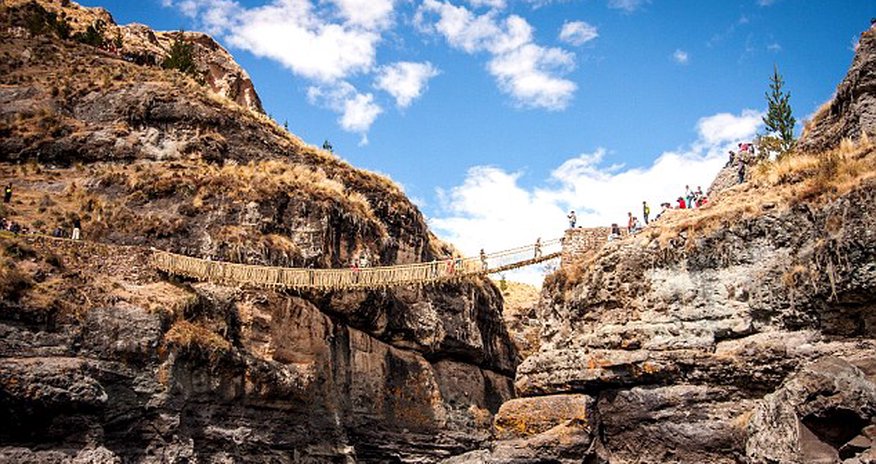
Five hundred years later, just one of the Inca rope bridges remains: the Keshwa Chaca, which spans the Apurimac River near Huinchiri, Peru, in the Province of Canas.
As they expanded their empire, the Incas built an entire network of bridges to move armies, people and goods quickly and efficiently over the mountains.
Even though it would take another 300 years before suspension bridges came to Europe, it is estimated that the Inca kingdom was connected by some 200, all made by hand.
The bridges were an integral part of the incredible Inca road system that stretches for 25,000 miles, from modern-day Ecuador to Argentina.
The last Incas disappeared in the early 17th century, and over the years their bridges followed.
The Keshwa Chaca remains thanks to local villagers who rebuild the bridge each year using the same techniques as their Inca ancestors.
It spans 90ft over the Apurimac River some 100ft below, and villagers claim it has been there for 500 years.
In the Inca days, local villagers would rebuild the Keshwa Chaca each year as a way of paying tax, but in modern times residents of the region keep the ancient tradition and skills alive by renewing the bridge every June.
After the bridge has been built, it is left to disintegrate before being constructed again the next year.
The raw material is 'ichu', a type of grass common on the sparse mountainsides of the Andes, which is braided into rope for the bridge.
Each household in the four nearby villages is responsible for bringing 90 feet of braided grass rope, Slate reports.
The bridge consists of five parallel 'ichu' ropes, which are braided to be about four inches thick, fastened at stone platforms on each side of the gorge.
The floor or walkway is of small sticks and canes, fastened transversely with raw-hide strings, and two thick ropes are tied between the platforms as armrails.
It takes three days to renew the Keshwa Chaca, and although it may look brittle, it has been proven to support the weight of 56 people standing across the walkway.
(dailymail.co.uk)


www.ann.az


Youtube
Follow us on Youtube


Similar news
Similar news

World 12:30
Iran Urges Middle East Nations to Reject US Military Support, Warns of Retaliatory Strikes











 Photo




 Video


