





Is Syria's war edging towards an outcome?
13.05.2015 14:30


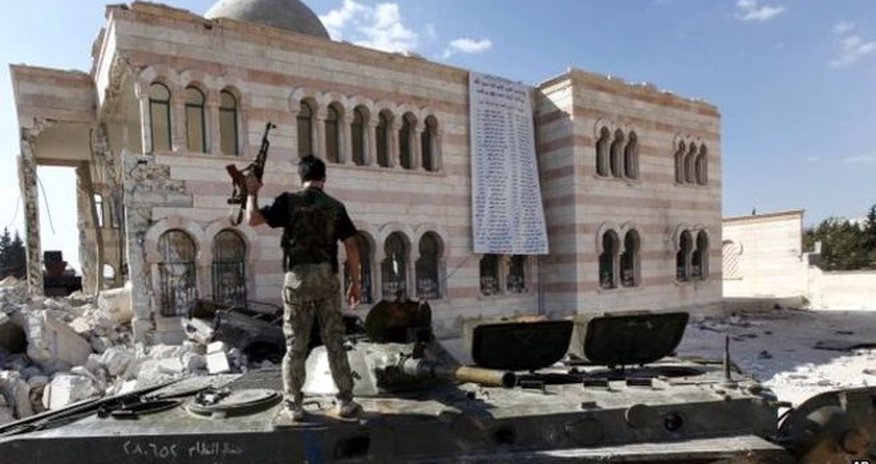
Syria's President Bashar al-Assad has dismissed recent battlefield reverses as just part of the ups and downs of a long-term war involving thousands of battles, and says victory remains inevitable.
His Lebanese ally Hezbollah, led by Hassan Nasrallah, whose fighters are playing a key role alongside Syrian government forces fighting the rebels, agrees that losing one round does not mean losing the war.
He too dismisses speculation about the future of the regime as tendentious psychological warfare.
But the outlook for the embattled Syrian leader undoubtedly looks grimmer now than at any time over the past two years.
Some of his adversaries and critics believe he is already gasping on the ropes and that there could be a sudden dramatic collapse at almost any moment.
Even some of his core constituents - and many ordinary citizens in Damascus and elsewhere - were deeply unsettled by recent regime losses, especially in the north-western province of Idlib, where the regional capital fell at the end of March to a rebel alliance, followed shortly by the strategic town of Jisr al-Shughour.
The regime had fought hard to retain those assets. Dismay at their loss became so widespread that Mr Assad clearly felt the need, for the first time since the war began four years ago, to say something publicly to acknowledge the setbacks and shore up morale.
It had been badly shaken by a widely-viewed leaked video showing a popular commander at Jisr al-Shughour, Col Suheil Hassan, known as "The Tiger", begging his superiors on his mobile phone to send ammunition and help.
There were fears that the losses in Idlib province could open the way for a rebel thrust into Latakia province, the coastal heartland of the Alawite minority community to which the president and his family belong.
Growing pressure
Setbacks in the south, including the rebel's capture of the main crossing-point on the Jordanian border at Nassib, compounded the feeling that the balance had tilted dangerously.
Some military analysts believe the regime, crippled by manpower shortages too severe for Hezbollah and other Iranian-backed Shia forces to compensate, is already preparing to shorten its defence lines by pulling out of the south and other areas deemed non-core, which could even include the government-controlled half of Aleppo in the north.
There are signs that pressure is building up within the regime.
"It's coming apart at the seams," said one diplomat. "They are starting to turn on each other like hungry wolves."
Two top security and intelligence generals, Rustum Ghazali and Ali Mamluk, have recently fallen victim to the tension.
Ghazali, head of the Political Security Directorate, was reported to have died in hospital last month after being beaten up by the bodyguards (apparently including Hezbollah operatives) of a rival general, Military Intelligence chief Rafiq Shahada.
Gen Mamluk, director of the National Security Bureau (NSB), has also been out of circulation for some time, reportedly sidelined because he, like Ghazali, resents Iran's pervasive influence in his country, the key issue that seems to be causing ructions.
Rebel reorganisation
Towards the end of 2012, the fall of Damascus - and the regime - seemed imminent and inevitable.
But it didn't happen. The situation turned around quite rapidly, and it wasn't long before a motley jumble of rebel groups were being pushed back on various fronts.
Could another such turnaround happen again now?
Anything is possible. But some of the givens in the equation have changed, ominously from the regime's point of view, in a way that convinces many observers that the situation has changed and a new phase is under way.
Major rebel factions, and their outside backers, have for the past several months been pulling together rather than fractiously competing as before.
This was translated fairly rapidly into the advances at Idlib and elsewhere.
The mainly Islamist but non-"Islamic State" rebel groups welded themselves together into a "Victory Army" for the Idlib operations. They have set up a similar front in the Qalamoun area, and also for Aleppo.
Running out of options
Lying behind this is a triangular rapprochement between the main regional powers backing the rebel factions: Saudi Arabia, Turkey and Qatar, who had long been working at cross purposes.
The Saudis in particular seem to have taken on a new sense of purpose after the accession of King Salman in January, taking a tougher and more proactive role against what they see as Iranian encroachment in the Arab arena, notably in Yemen and Syria.
If that cohesion and drive can be maintained and developed by the rebels' outside backers, it would be seriously bad news for Mr Assad.
When the tide seemed to be coming in about him two-and-a-half years ago, he managed to turn things around by going to Moscow and Tehran and persuading his allies there to give him what he needed to stay in business.
The Russians provided arms and diplomatic support. The Iranians opened the financial sluices to the tune of billions of dollars a year; financed, armed and trained local National Defence Forces militia; and provided huge military support, both directly through advisers and by organising the involvement of Hezbollah from Lebanon and other Shia fighters from Iraq, Afghanistan and elsewhere.
But those cards have been played, and seem to be fraying.
Hezbollah made a huge difference, but it cannot be everywhere and fight all the regime's battles for it, as Idlib showed.
Nor is Iranian bounty endless. Tehran is heavily squeezed by sanctions and low oil prices, hence its willingness to seek a deal with the Americans and others over its nuclear ambitions.
"It's all about pressure on Iran," said a Western diplomat closely following Syrian affairs. "The message is: 'You're out of money, and you can't win the war.'"
'Grand Deal'
The absence of further rabbits to pull out of the hat is why some diplomats are cautiously hopeful that the low-key peace consultations launched in Geneva by the UN special envoy for Syria, Staffan de Mistura, might just bear fruit.
He is hoping to report progress back to the UN Security Council around the end of June - the same date set for the Iranian nuclear negotiations to produce a final detailed agreement.
The Saudis and their Gulf partners fear that if such an accord is sealed, it will give Iran the leeway and finances to intensify its regional ambitions.
But some others believe it is - or could be - implicitly linked to a prospective easing of tensions over Syria, Yemen and the regional Sunni-Shia rift, speculating that US President Barack Obama - who holds unusual talks with the Gulf Co-operation Council leaders in Washington this week - may want to engineer a "Grand Deal" as his legacy achievement.
Under that rosy scenario, the Iranians would take on the task of removing Mr Assad and his top security circle and assuring a smooth transition to someone who could negotiate a settlement on behalf of what is left of the regime.
If the balance on the ground in Syria really has shifted, both Tehran and Washington might see that as in their interest. Neither wants to see a regime collapse and a sudden rush of more or less extremist Sunni Islamist elements to fill the vacuum.
By using their unique influence and penetration in Damascus to engineer the removal of Mr Assad and a transition to a figure acceptable as an interlocutor to the rebels and their regional backers, for whom the demise of the hated ruler is a must, the Iranians could at least hope to secure the "useful" parts of Syria rather than lose everything.
The Americans have just launched a programme to train and and equip 15,000 carefully-vetted "moderate" rebel fighters over the next three years - but with the war against Islamic State much more in mind that confronting the regime.
So far, a mere 90 recruits have been approved to embark on the project, which is widely regarded as belated, misplaced and doomed. It certainly risks being outpaced by events.
Common interests
The Americans have never wanted the rebels to overthrow Mr Assad and win the war. Their aim has been to use rebel pressure to induce the ruler to step aside and make way for a stable political settlement and transition.
If Iran has drawn the conclusion that that would be the only way to save its investment and its corridor to its Hezbollah proxy in Lebanon, there could be a convergence of interests, as has happened against Islamic State in Iraq.
(BBC)
www.ann.az


Youtube
Follow us on Youtube


Similar news
Similar news
World 12:30
Iran Urges Middle East Nations to Reject US Military Support, Warns of Retaliatory Strikes




 Photo




 Video


