





He was the saviour of Afghan music. Then a Taliban bomb took his hearing
26.05.2015 13:00


When Ahmad Sarmast said he would give his life to music, he meant it quite literally.
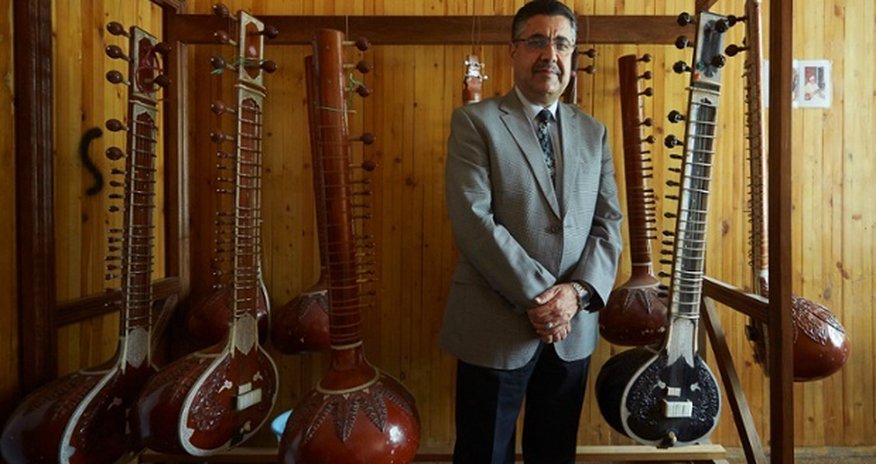
After more than a decade in Australia, Sarmast, a musicology professor and son of a renowned conductor, returned to Afghanistan after the fall of the Taliban to establish the country’s first institute for classical music.
After a ban on music during the Taliban’s rule, Sarmast ushered in a musical revolution.
Not only did he create a symphony orchestra, which soon played some of the world’s largest venues including the Kennedy Centre in Washington and the Royal Festival Hall in London, but he also deliberately reserved a number of slots in the orchestral institute for orphans, street children and, most controversially in Afghanistan, girls.
But a few months ago, the insurgents came close to silencing Sarmast and his orchestra.
On 11 December, the professor was enjoying the fruits of many months’ labour when his orchestra performed alongside a drama troupe at the French cultural centre in Kabul. Sarmast was seated in the front row.
"The show was a beautiful one. The music was so powerful, the actors’ playing so masterly,” Sarmast remembered.
At one point during the performance, he heard a commotion outside the hall. Following routine, he reached for his mobile phone to check if his driver had alerted him to anything.
That second, a blast ripped through the crowd. Sarmast was knocked unconscious. "I felt like someone with a cricket bat hit my head with his entire energy and power,” Sarmast recalled.
Police later told him he had been sitting only a few seats away from the suicide bomber. When he regained consciousness, Sarmast felt "a very warm liquid all over my body. When I touched, I saw there was a lot of blood.”
He had survived the attack, in which a German man was killed, but he was far from unscathed. Eleven pieces of shrapnel had lodged in the back of his head. And, immediately after the attack, Sarmast had difficulties hearing. An hour later, a man whose entire life revolved around music had become completely deaf.
"At that moment, I thought: ‘You’re a musician, you’re dealing with music, what is going to happen?’” Sarmast said. "But when you are between life and death, I was happy that I was alive.”
His hearing gradually returned, but it was severely damaged. In his sleep, the sound of the blast kept returning.
"[The sound] was probably a combination of the shrapnel entering my head, and the explosion itself,” he said. "The nightmares were different, but the sound was exactly the same. Very loud, very scary.”
Sarmast flew to Australia to undergo surgery, but for many weeks he could barely hear high notes, while bass notes were overwhelmingly loud. "I had the feeling, twenty-four seven, that a large symphony orchestra was playing out of tune in both ears. That was very, very annoying and demoralising,” he said.
Eventually, surgeons removed the shrapnel from his skull and restored his hearing to a level where he could distinguish instruments and once again enjoy the sound of a full orchestra. In April, Sarmast returned to Kabul.
Walking the halls of the Afghan National Institute of Music, Sarmast surveyed students and teachers at work. In one room, a trio of teenagers practised scale patterns on Spanish guitars. Next door, 10 children rehearsed a fast-paced, bouncy tune on traditional instruments including tablas, drums and rubab, a stringed instrument.
In the big auditorium, the youth orchestra, the crown jewel of the school, was polishing up Beethoven’s Egmont and an intermezzo from Bizet’s Carmen. The orchestra included former street children, orphans and children of middle-class families. It was as diverse in ethnicity as it was in age. Boys and girls sat side by side, a sight still unseen in most parts of the country.
(Guardian)
www.ann.az


Instagram
Follow us on Instagram
Similar news
Similar news

World 12:30
Iran Urges Middle East Nations to Reject US Military Support, Warns of Retaliatory Strikes











 Photo




 Video


