





Kim Jong-un: Trying to make sense of North Korea's leader
09.06.2015 19:00


There must be some truth in between, mustn't there?
Outside North Korea, Kim Jong-un is depicted as a monster. Or a buffoon who sends his goons around to a London hairdresser who dared to poke fun at his haircut. Or a portly playboy with a liking for Swiss cheese, fast cars and faster women.
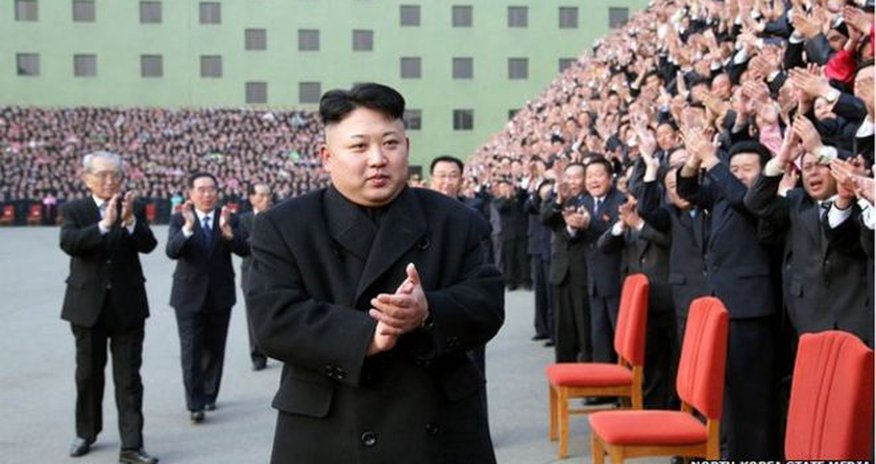
But inside North Korea, he is a monarch, the supreme leader, with an almost god-like aura. His people applaud until their hands must be raw.
The state media reports how he travels the country and imparts his guidance, recently, for example, on farming terrapins.
The Rodong Sinmun, the official newspaper of the Korean Workers' Party, reported that the breeding establishment in Pyongyang had been set up on the initiative of his father, Kim Jong-il, "to provide the people with tasty and nutritious terrapin widely known as precious tonic from olden times".
His guidance was sorely needed because it transpired that the farm had not been performing well either in breeding terrapins or ideologically. The newspaper quoted Kim Jong-un thus: "It is hard to understand that the farm did not arrange even the room for the education in the revolutionary history."
On top of that, a venture to breed lobsters had failed. This was not a good day at the Taedonggang Terrapin Farm.
Feeling of 'could be next'
This all illustrates how difficult it is to make sense of the man. The image of the global bete noir is burnished or tarnished by propagandists on all sides. But the recent allegations from the South Korean intelligence agency that a purge of officials had been taking place took people by surprise, proving that he is unpredictable even for experts in North Korea.
Outside experts are not hopeful. Some think his recent actions have been erratic in a way which was not there with his father. Under Kim Jong-il, the people around him tended to survive - generals kept their jobs and their heads - and this meant that the leadership circle supported the leader.
Now, so the argument runs, the sudden execution of Kim Jong-un's mentor and uncle, Chang Song-thaek, and perhaps of the Defence Minister, Hyon Yong-chol, must make those around him fear that they might be next - and fear of sudden and unpredictable death might lead people with power to act first.
Aidan Foster-Carter, honorary senior research fellow at Leeds University, says: "If loyal cadres feel they could be next, at any time and for no reason, that undermines loyalty and could even be an incentive to defect."
Or worse: "If the elite doesn't feel safe, you wonder in what circumstances they might move against him."
Out of his depth
It then becomes a calculation of whether loyalty or extreme disloyalty minimises danger.
Plotters don't tend to have long life expectancies:
the plots to kill Hitler all failed, and those plotters who were caught were invariably executed
Stalin eliminated all potential opposition
in South Korea, President Park Chung-hee was assassinated over dinner by his own intelligence chief, who was then tried and hanged
Mr Foster-Carter detects a man who is out of his depth. "There's no evidence of ability," he told the BBC. "Kim Jong-il was unknown for a while, but we now know that he was very competent. He had had 20 years being groomed for leadership by his father."
Kim Jong-un, in contrast, was catapulted into the job in his late 20s after spending much time abroad, in Switzerland at school, so he's something of an outsider in Pyongyang and may not be completely easy with the way politics works there.
(BBC)
www.ann.az


Youtube
Follow us on Youtube


Similar news
Similar news
World 12:30
Iran Urges Middle East Nations to Reject US Military Support, Warns of Retaliatory Strikes






 Photo




 Video


