





Facial discrimination: Living with a disfigured face
29.05.2020 08:55


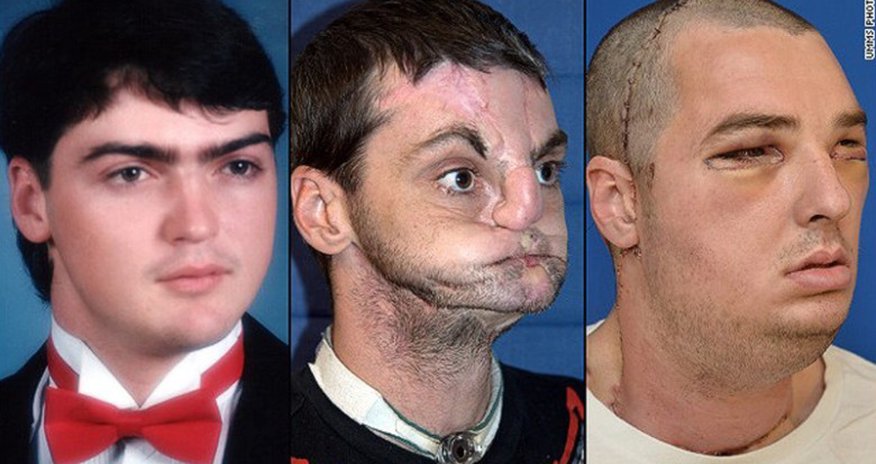
"Take your ear off for me, please," Rosie Seelaus says to Randy James, who is sitting on a black exam chair in a special room designed for viewing colors in the Craniofacial Center on the Near West Side of Chicago.
He reaches up and detaches his right ear, which she created for him out of silicone seven years before. The ear is shabby, stained from skin oil and mottled by daily use. Viewed under various lights in the neutral, gray-walled room -- daylight, incandescent, fluorescent -- it remains a pasty beige.
James is a doctor with the Department of Veterans Affairs in Las Vegas -- the fierce desert sunlight is also tough on his prosthetic ear. Seelaus is an anaplastologist, a clinician who sculpts artificial body parts for people who have lost them through injury or disease or, as with James, who never had them to begin with.
He was born 58 years ago with Goldenhar syndrome, a genetic condition that distorts the fetal face, sometimes severely. Some children with Goldenhar, like James, are born missing an ear or part of an ear (he had only the right lobe). Some have bulging eyes, or no eyes at all. James's jaw was undersized and skewed. He underwent 35 surgeries, including one to construct his right cheekbone using bone shaved from his ribs. He pulls up his shirt to show off slashing scars across his ribcage.
"I used to tell bullies I was mauled by a tiger at the zoo," he says.
The first time I walked through the corridors of the Craniofacial Center, on the University of Illinois at Chicago's medical campus, I had to sit down. Not that I was going to faint, but the immediate possibility occurred to me. So I filled a paper cup with water and carefully lowered myself into a chair.
And that was before meeting any patients. Seeing the mute plaster molds of cleft faces, the blindly staring glass eyes and the little pyramids of false noses was enough. A baby's hand, made of silicone, grasped at the air.
That was 15 years ago. I'm not sure whether I was more or less scared of people with disfigurements than is average. As a child I had been terrified. Even of the small square picture on page 289 in the American Heritage Dictionary illustrating "contortionist," an early-20th-century photograph of a circus acrobat, her chin propped against the back of a chair, her body twisted impossibly above it, a foot planted on either side of her disembodied head. I would turn the pages of the Cs very slowly, steeling myself.
Most frightening of all, Cynthia Cowles, in Mrs Farmer's first grade class at Fairwood School, her eyes set too far apart, her nose flattened. We boys teased her relentlessly, so much that her mother phoned my mother, asking her to make me stop.
"I felt helpless," my mother told me, years later. "The things you were upset about, you'd open your mouth about."
Misperceptions
Fear of people with facial disfigurements is a common phobia, yet, unlike other fears -- of height, of water, of the dark -- it is seldom discussed, perhaps because so much popular culture, from The Iliad to Saw V, pivots upon this fear. Perhaps it is assumed: of course you are afraid of the man without a face. Who wouldn't be?
Or perhaps because, unlike fear of high places, water or the dark, teratophobia -- fear of disfigured people or of giving birth to a disfigured baby, literally 'fear of monsters' -- has a living object: the injured, burnt, unusual-looking people themselves. Drawing attention to the flinching reaction they often receive, the stares and mockery that are a routine part of their daily lives, can seem an additional cruelty, the sort of vileness enjoyed by schoolyard bullies.
Read: A beauty beyond skin deep
Why are distorted faces so frightening? Freud classified certain objects as 'unheimlich,' a difficult-to-translate word akin to 'uncanny': strange, weird, unfamiliar. Waxwork dummies, dolls, mannequins can frighten us because we aren't immediately sure what we're looking at, whether it's human or not, and that causes anxiety. A surprisingly large part of the human brain is used to process faces. Identifying friend from foe at a distance was an essential survival skill on the savannah, and a damaged face is thought to somehow rattle this system.
The psychologist Irvin Rock demonstrated this in his landmark 1974 paper 'The perception of disoriented figures.' Rock showed that even photos of familiar faces -- famous people like Franklin D Roosevelt, for instance -- will look unsettling when flipped upside down. Just as, if you tip a square enough it stops being a square and starts becoming a diamond, so rotating a face makes it seem less like a face. The mind can't make immediate sense of the inverted features, and reacts with alarm. A bigger change, such as taking away the nose, transforms the face severely enough that it teeters on no longer seeming a human face at all, but something else.
That isn't a theoretical example picked out of the air. On another visit to the Craniofacial Center, I enter Seelaus's examination room to be introduced to a patient. He turns in the chair, and is missing the middle part of his face. There are four magnetic posts where his nose will go, and below it, a void revealing smooth yellow plastic. My eyes lock on his eyes, I shake his hand and say some words.
A half-hour later, standing on the elevated train platform, I still feel ... what? 'Harrowed' is the word that eventually comes to mind. Why? There was no surprise. I'm no longer a child but an adult, a newspaper reporter who has spent hours watching autopsies, operations, dissections in gross pathology labs. I was expecting this; it's what I came here for. What about his face was so unsettling?
Maybe seeing injured faces compels an observer to confront the random cruelty of life in a raw form. Maybe it's like peeling back the skin and seeing the skull underneath. Like glimpsing death. Maybe it touches some nameless atavistic horror. That's as far as I get before the train arrives and I get on.
(CNN)
www.ann.az


Facebook
Follow us on Facebook


Similar news
Similar news

World 12:30
Iran Urges Middle East Nations to Reject US Military Support, Warns of Retaliatory Strikes








 Photo




 Video


