





The carpenter who almost killed Hitler
08.07.2015 16:30


13 Minutes, the new film from the director of Downfall, shows how close a lowly carpenter came to assassinating the Führer in 1939. Who was Georg Elser, and why did he fail?
By the summer of 1944, the British and Americans had dropped all plans to assassinate Hitler. They had realised that the Führer had become their secret weapon; such was his irrational behaviour and general incompetence as a military strategist.
There was also a growing understanding, gleaned from bugging the prison cells of captured German officers, that the Nazis were so fanatical they would have to be defeated unambiguously. An assassination, such as the one attempted by Colonel von Stauffenberg on July 20 1944, could have been interpreted as a stab in the back by treacherous officers and a version of the Nazi Party may have remained in power for decades after the war.
As it was, their unconditional surrender in 1945 was followed by a programme of denazification, as well as the Nuremburg trials.
Everyone has heard of the July 20 plot, thanks, not least, to the 2008 film Valkyrie, which starred Tom Cruise as von Stauffenberg. But how many of us are aware that that was the second dramatic attempt on Hitler’s life by one of his own people?
The first came on November 8, 1939, two months after the war began, and the story behind it has now been made into 13 Minutes, a gripping and thought-provoking film by Oliver Hirschbiegel, best known as the award-winning director of Downfall (2004).
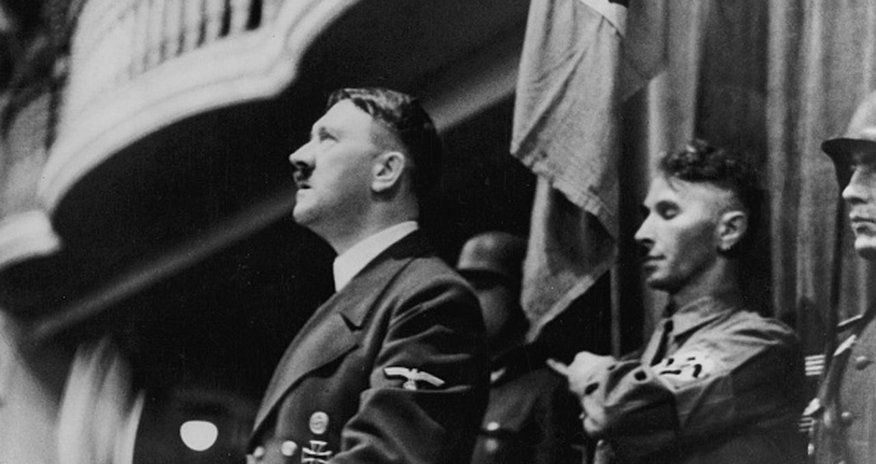
The assassination attempt involved a huge time bomb. The idea was that it would be detonated in Munich’s Bürgerbräukeller in a column immediately behind the lectern where Hitler would be making the speech he made every year, in the same place, at the same time, to mark the anniversary of the 1923 "Beer Hall Putsch”. Unfortunately the Nazi leader left the Bürgerbräukeller earlier than scheduled that night, 13 minutes before the bomb went off.
Had that attempt on his life succeeded it would, unlike the July 20 plot, have been an unequivocally good thing. Indeed it might well have saved the lives of 40 million people, because Hitler’s senior henchmen — including Himmler, Goebbels, Hess, and Reinhard Heydrich, the architect of the Holocaust — were also there, sitting in the front row, and they would have been killed along with him. As it was, they left with him, and the bomb brought down the ceiling and the walls, leaving a pile of rubble. Eight members of the audience, including a waitress, were killed instead.
So why was the timing out by 13 minutes? Fate, according to Hitler. He had cut his normal two-hour speech down to one because fog was forecast, meaning he would have to return to Berlin by train that night rather than plane. When he was told of the bombing, he said: "My leaving the Bürgerbräukeller earlier than usual is proof to me that Providence wants me to reach my goal.”
Perhaps what is most remarkable about the November 8 plot is that, unlike the elaborate July 20 plot, which involved hundreds of conspirators, there was only one person involved. His name was Georg Elser and he was a 36-year-old carpenter and accordion player from a village in the countryside. He was known for his charm and affability, and had something of a reputation as a ladies’ man, indeed he was having an affair with a married woman at the time of the plot, and she went on to carry his child.
Yet for all his libertine behaviour, he also had a highly developed conscience. He had watched the brutal rise of the Nazis, seen how they poisoned the daily life of his fellow villagers, not least by arresting some of his left leaning friends on trumped up charges, and decided that something had to be done to stop them.
His assassination attempt was a year in the planning. On November 8 1938, the eve of kristallnacht, he went to watch the anniversary speech at the Bürgerbräukeller, but wasn’t allowed in until Hitler and his entourage had left. As the crowds dispersed he studied the column behind the lectern and decided that would be the best place to hide a bomb the following year.
He then spent months appropriating cartridges of pressed gunpowder, as well as fuses, from the quarry where he worked, and then, without any training in bomb making, he began work on the design for his improvised detonation device, using a car indicator and the mechanism of a clock. What he created was one of the world’s first time bombs, and it was so sophisticated it even had a back up timer in case the first failed.
Elser returned to the Bürgerbräukeller in April 1939 and took exact measurements of the column where he intended to hide his device. He tested the prototype of his bomb that summer in a remote orchard, then returned to Munich in the autumn and, having tried and failed to get a job at the beer hall, he broke in one night and began working on his hands and knees to hollow out a space in the column where he could install his device.
As the place was patrolled at intervals by a guard with a dog, he had to work in the dark, with a flashlight held between his teeth. It took him thirty nights to complete his mission. On November 5 he set his two-timer fuses to go off at 9.20pm in the middle of Hitler’s speech three nights later. He then disguised where the bomb was hidden with a false wall.
Elser had planned to escape across the border into Switzerland but, following a routine search, he was caught in possession of wire cutters, firing pins, bomb making plans and, most incriminating of all, a postcard of the interior of the Bürgerbräukeller. He was sent to Berlin for interrogation by Heinrich Müller, the head of the Gestapo, and Arthur Nebe, the head of the Kripo (the criminal police).
When Hitler heard that his would be assassin was a humble country carpenter he refused to believe it, or at least was in denial about it, because he saw himself as a champion of the ordinary working man. He assumed that Elser must have been working for the communists, or the English, and demanded proof to support this theory. But no amount of torture could get Elser to change his story that he had acted alone.
Only when he was able to show the Gestapo in detail how he made his bomb, and explain exactly how he got hold of the materials, did they finally accept his story. Nebe, his interrogator, later confided to a diplomat friend: "Elser laid out for me passionately and in simple sentences how, for the masses in all countries, war means hunger, misery, and the death of millions. Not a pacifist in the usual sense, his reasoning was quite simplistic: Hitler is war — and if he goes, there will be peace.”
(telegraph.co.uk/)
www.ann.az


Telegram
Follow us on Telegram


Similar news
Similar news

World 12:30
Iran Urges Middle East Nations to Reject US Military Support, Warns of Retaliatory Strikes











 Photo




 Video


