





Deal on Iran arms, sanctions viewed as near
13.07.2015 10:00


The United States and five other world powers appear on the cusp of a historic deal with Iran to curtail its ability to pursue a nuclear weapon in return for lifting stern economic sanctions, capping 16 days of tense negotiations that have resulted in three blown deadlines and many frayed nerves.
The deal could still get derailed or delayed, with negotiators not settled Sunday night on final language. Also, officials still need to check back with their home countries on whether they should sign off on a lengthy document spelling out the parameters of the agreement.
But several negotiators said many issues have been resolved, and an announcement could come as early as Monday. US officials have continued to urge caution and suggest that they could get 99 percent of the way there and still see the deal collapse.
The agreement, if it is finalized and then survives congressional opposition, would aim to cut off pathways for Iran to pursue a nuclear weapon for the next 10 to 15 years.
A deal could be a watershed event, given the deep distrust that has existed between Iran and the United States over the past 35 years, and would mark a signature accomplishment for Secretary of State John Kerry and his belief in using diplomacy to preempt war.
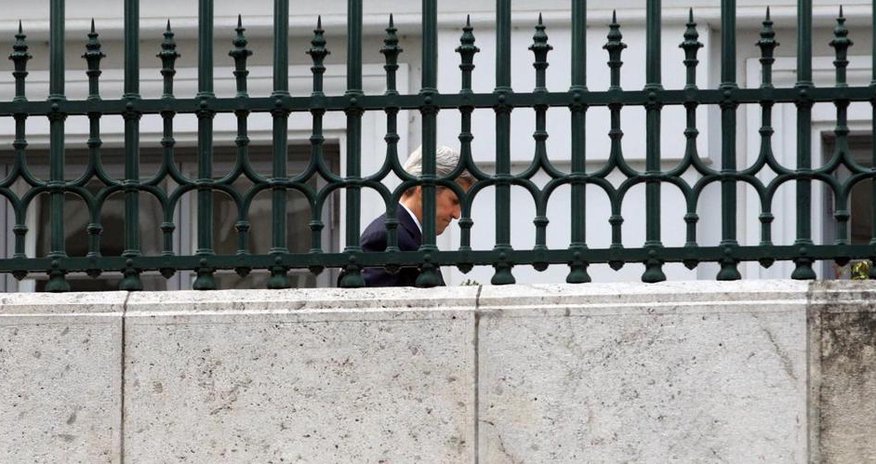
Kerry on Sunday morning said twice that he was hopeful that an agreement was near, adding that he had a "very good meeting” on Saturday night with Foreign Minister Mohammad Javad Zarif of Iran. It was a slight shift in his tone from a few days earlier, when he stood outside the Palais Coburg and threatened to walk away from the talks if progress wasn’t made.
"I think we’re getting to some real decisions,” Kerry said Sunday as he left his hotel and prepared to attend Mass at nearby St. Stephen’s Cathedral. "So I will say, because we have a few tough things to do, I remain hopeful. Hopeful.”
Kerry and Zarif met on Sunday night for 37 minutes — their only meeting of the day — before Kerry left for a dinner with the other world powers trying to come to terms with Iran.
The broad parameters of the agreement would restrict Iran’s ability to pursue a nuclear weapon — forcing it to shed some materials and submit to more intrusive international inspections — in return for the lifting of economic sanctions.
But over the past two weeks there have been deep and lasting disputes between the two sides over the timing of the sanctions.
One major sticking point became a push by Iran, as well as Russia, for the United Nations to lift an embargo on the weapons that Iran can import and export.
If an agreement is reached, it would then be presented to Congress, which would have 60 days to review and vote on it before the terms begin to be locked into place. Even in the absence of final text, Republicans have already criticized Kerry and President Obama as caving to Iranian demands, and in the coming days are prepared to seize on a number of provisions that will receive close scrutiny.
Opponents would need at least a two-thirds majority to override a presidential veto of a congressional resolution rejecting the deal. Obama has already started lobbying Democrats.
"It appears as if the administration’s approach to this was to reach whatever agreement the Iranians are willing to enter into,” said Mitch McConnell, the Senate majority leader, on "Fox News Sunday.’’ "So I think it’s going to be a very hard sell — if it’s completed — in Congress.”
House Speaker John Boehner said on CBS’ "Face the Nation” that, "No deal is better than a bad deal.”
Senator Bob Menendez, a New Jersey Democrat, also reiterated his qualms about the emerging contours of the deal. One area that is bound to be scrutinized is that restrictions on Iran’s nuclear pursuits may be eliminated after 10 or 15 years.
"We have gone from preventing Iran having a nuclear ability to managing it,” Menendez said on ABC’s "This Week.”
"And at the end of the day, I hope that notwithstanding a deal, that the president makes a very clear statement to Iran that as it relates to the future, we cannot accept Iran having a nuclear weapon, period,” he added.
After a round of meetings that went late into the night on Saturday, progress was moving forward enough that there was talk of a deal being announced on Sunday, but Iranian and American officials said there were still final details to be worked out.
"We are working hard, but a deal tonight is simply logistically impossible,” Alireza Miryousefi, a spokesman for the Iranian delegation, said on Twitter. "This is a 100-page document, after all.”
One sign of progress was that Foreign Minister Sergey Lavrov of Russia returned to Vienna, and Foreign Minister Wang Yi of China was also expected back.
Foreign Minister Philip Hammond of Britain returned to London on Sunday night, but was planning to be back in Vienna on Monday.
"I hope, I hope, that we are finally entering the final phase of this marathon negotiation,” Foreign Minister Laurent Fabius of France told reporters after arriving Sunday from Paris.
A senior State Department official also downplayed the idea that a deal would be announced on Sunday, but left open the possibility that it would come soon.
"We have never speculated about the timing of anything during these negotiations, and we’re certainly not going to start now — especially given the fact that major issues remain to be resolved in these talks,” said a senior State Department official.
On Sunday morning, Kerry engaged in some of the more leisurely activities that he has largely been unable to do amid the blizzard of late-night meetings and long days.
First, he left for a 40-minute Mass at St. Stephen’s Cathedral, a 12-century Gothic cathedral where Wolfgang Amadeus Mozart was wed, where the funeral for Italian composer Vivaldi was held, and where President John F. Kennedy came to worship in 1961.
After some meetings with the US delegation, the secretary of state went on a visit to Mozarthaus, where Mozart once lived.
Some, including Kerry, have hoped that a deal with Iran might lead to a new outlook in the Middle East.
But Ayatollah Ali Khamenei on Saturday harshly reiterated how he views the United States.
"The struggle with the arrogant power does not end after a deal; it will be continued,” Khamenei told a group of university students, according to Iran’s state-run Press TV.
"America is the quintessential arrogant power,’’ he said. "Be ready for struggle with the arrogant power.”
Still, Iranian officials on Sunday were reportedly preparing for celebrations once a deal is announced.
www.ann.az


Telegram
Follow us on Telegram


Similar news
Similar news

World 12:30
Iran Urges Middle East Nations to Reject US Military Support, Warns of Retaliatory Strikes











 Photo




 Video


