





The secret to ISIS's success
10.08.2015 19:30


Once part of one of the most brutal dictator's army in the Middle East, over 100 former members of Saddam Hussein's military and intelligence officers are now part of ISIS.
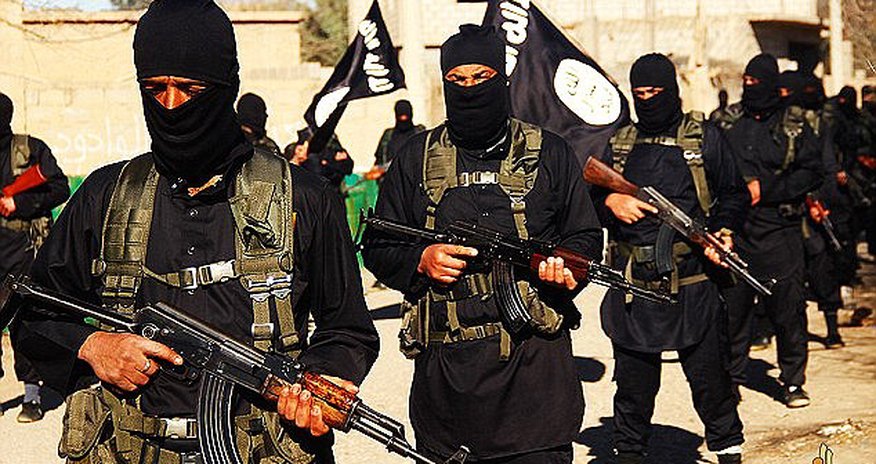
Now they make up the complex network of ISIS's leadership, helping to build the military strategies which have led the brutal jihadi group to their military gains in Syria and Iraq.
The officers gave ISIS the organization and discipline it needed to weld together jihadi fighters drawn from across the globe, integrating terror tactics like suicide bombings with military operations.
While attending the Iraqi army's artillery school nearly 20 years ago, Ali Omran remembers one major well. An Islamic hard-liner, he once chided Omran for wearing an Iraqi flag pin into the bathroom because it included the words 'God is great.'
'It is forbidden by religion to bring the name of the Almighty into a defiled place like this,' Omran recalled being told by Maj. Taha Taher al-Ani.
Omran didn't see al-Ani again until years later, in 2003. The Americans had invaded Iraq and were storming toward Baghdad. Saddam Hussein's fall was imminent.
At a sprawling military base north of the capital, al-Ani was directing the loading of weapons, ammunition and ordnance into trucks to spirit away. He took those weapons with him when he joined Tawhid wa'l-Jihad, a forerunner of al-Qaida's branch in Iraq.
Now al-Ani is a commander in the Islamic State group, said Omran, who rose to become a major general in the Iraqi army and now commands its 5th Division fighting IS.
He kept track of his former comrade through Iraq's tribal networks and intelligence gathered by the government's main counter terrorism service, of which he is a member.
They have been put in charge of intelligence-gathering, spying on the Iraqi forces as well as maintaining and upgrading weapons and trying to develop a chemical weapons program.
Patrick Skinner, a former CIA case officer who has served in Iraq, said Saddam-era military and intelligence officers were a 'necessary ingredient' in the Islamic State group's stunning battlefield successes last year, accounting for its transformation from a 'terrorist organization to a proto-state.'
'Their military successes last year were not terrorist, they were military successes,' said Skinner, now director of special projects for The Soufan Group, a private strategic intelligence services firm.
The group's second-in-command, al-Baghdadi's deputy, is a former Saddam-era army major, Saud Mohsen Hassan, known by the pseudonyms Abu Mutazz and Abu Muslim al-Turkmani, according to the intelligence chief.
Hassan also goes by Fadel al-Hayali, a fake name he used before the fall of Saddam, the intelligence chief, who spoke under the condition of anonymity to The Associated Press.
During the 2000s, Hassan was imprisoned in the notorious U.S.-run Bucca prison camp, the main detention center for members of the Sunni insurgency, where al-Baghdadi also was held.
The prison was a significant incubator for the Islamic State group, bringing militants like al-Baghdadi into contact with former Saddam officers, including members of special forces, the elite Republican Guard and the paramilitary force called Fedayeen.
In Bucca's Ward 6, al-Baghdadi gave sermons and Hassan emerged as an effective organizer, leading strikes by the prisoners to gain concessions from their American jailers, the intelligence chief said.
Former Bucca prisoners are now throughout the IS leadership. Among them is Abu Alaa al-Afari, a veteran Iraqi militant who was once with al-Qaida and now serves as the head of IS's 'Beit al-Mal,' or treasury, according to a chart of what is believed to be the group's hierarchy provided to the AP by the intelligence chief.
Al-Baghdadi has drawn these trusted comrades even closer after he was wounded in an airstrike earlier this year, the intelligence chief said.
He has appointed a number of them to the group's Military Council, believed to have seven to nine members - at least four of whom are former Saddam officers. He brought other former Bucca inmates into his inner circle and personal security.
Saddam-era veterans also serve as 'governors' for seven of the 12 'provinces' set up by the Islamic State group in the territory it holds in Iraq, the intelligence chief said.
Iraqi officials acknowledge that identifying IS leadership is an uncertain task. Besides al-Baghdadi himself, the group almost never makes public even the pseudonyms of those in its hierarchy.
When leaders are killed, it's often not known who takes their place - and several have been reported killed multiple times, only to turn up alive. Figures are believed to take on new pseudonyms, leaving it unclear if a new one has emerged or not.
'IS's military performance has far exceeded what we expected. The running of battles by the veterans of the Saddam military came as a shock,' a brigadier general in military intelligence told the AP, speaking on condition of anonymity to discuss the sensitive topic.
'Security-wise, we are often left unable to know who replaces who in the leadership. We are unable to infiltrate the group. It is terrifying.'
Estimates of the number of Saddam-era veterans in IS ranks vary from 100 to 160 in mostly mid- and senior-level positions, according to the officials.
Typically, they hail from Sunni-dominated areas, with intelligence officers mostly from western Anbar province, the majority of army officers from the northern city of Mosul and members of security services exclusively from Saddam's clan around his hometown of Tikrit, said Big. Gen. Abdul-Wahhab al-Saadi, a veteran of battles against IS north and west of Baghdad.
For example, a former brigadier general from Saddam-era special forces, Assem Mohammed Nasser, also known as Nagahy Barakat, led a bold assault in 2014 on Haditha in Anbar province, killing around 25 policemen and briefly taking over the local government building.
Many of the Saddam-era officers have close tribal links to or are the sons of tribal leaders in their regions, giving IS a vital support network as well as helping recruitment.
These tribal ties are thought to account, at least in part, for the stunning meltdown of Iraqi security forces when IS captured the Anbar capital of Ramadi in May.
Several of the officers interviewed by the AP said they believe IS commanders persuaded fellow tribesmen in the security forces to abandon their positions without a fight.
Skinner, the former CIA officer, noted the sophistication of the Saddam-era intelligence officers he met in Iraq and the intelligence capabilities of IS in Ramadi, Mosul and in the group's de facto capital of Raqqa in Syria.
'They do classic intelligence infiltration. They have stay-behind cells, they actually literally have sleeper cells,' Skinner said.
(dailymail.co.uk)
www.ann.az


Facebook
Follow us on Facebook


Similar news
Similar news

World 12:30
Iran Urges Middle East Nations to Reject US Military Support, Warns of Retaliatory Strikes











 Photo




 Video


